

Category: Franz Liszt

  • “Story Behind” Series #8 – May 7, 2021

    Published on Franz Liszt Group, on May 7, 2021. If you want to know how the Story Behind series started, I give details in “Story Behind” Series #1″.


    My mind and fingers have worked like the damned. Homer, the Bible, Plato, Locke, Lamartine, Chateaubriand, Beethoven, Bach, Hummel, Mozart, Weber are all around me. I study them. I devour them with fury.
    Franz Liszt
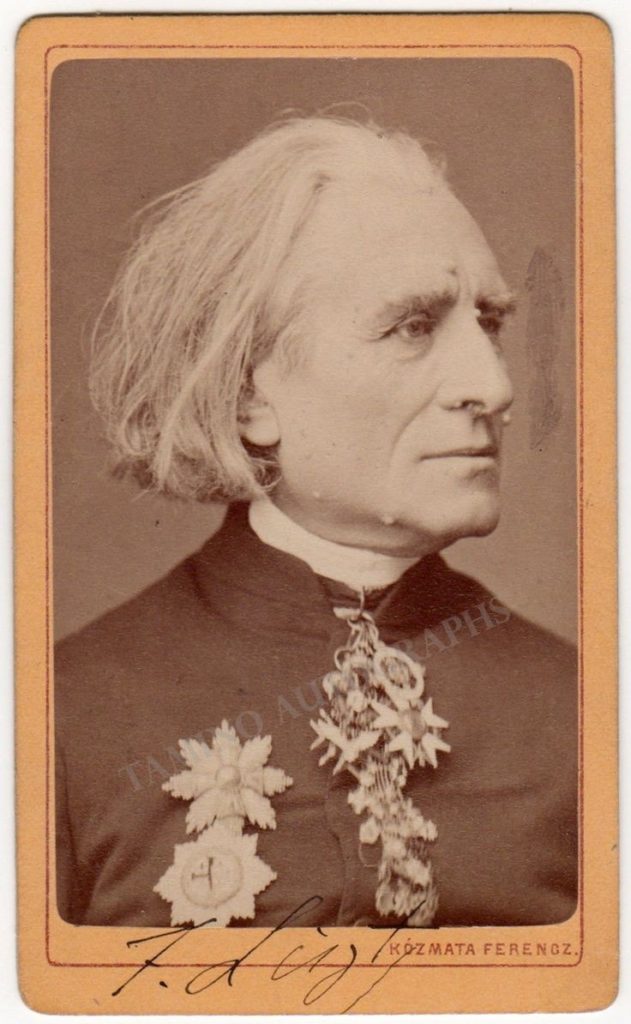
    Visit card with a picture of Liszt in sepia colour. The picture was taken in 1873. Liszt is wearing a cassock and some decorations are pinned on his chest. He looks toward his left. Liszt signed the bottom of the card.

    Conversation and story behind:

    Group member:

    Quote from about 1830.

    Diane Kolin:

    Ready for a quote and picture backgrounds? 🙂

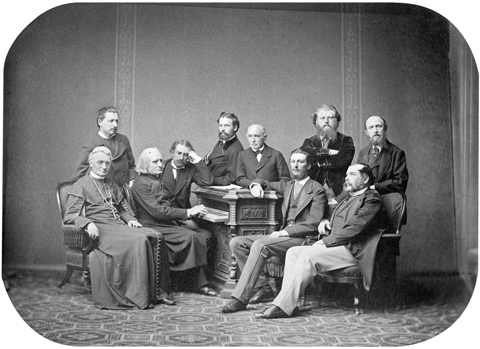
    Actually, this is a quote dated May 2nd, 1832, in a letter Young Liszt (21 years old) wrote to his friend Pierre Wolff in Paris. The quote goes on: “Ah! provided I don’t go mad, you will find an artist in me! Yes, an artist such as you desire, such as is required nowadays.” He is also mentioning in this letter Paganini’s performance that put him in a state of excitement and pushed him to challenge himself to become an even better pianist. As for the picture, it was taken much later, in 1873, in Budapest by photographer Ferencz Kozmata. Kozmata took pictures of Liszt during years 1873 to 1875, each time he was coming to Pest. He didn’t take only single portraits in his Studio. He was the photographer who took the famous picture of Liszt’s 50th anniversary as an artist in Pest (Liszt was 12 when he performed for the first time in Pest in 1823, and was 62 at the moment this picture was taken, in November 1873), where Liszt appears surrounded by Archbishop Lajos Haynald, Imre von Huszár, Count Imre Széchényi, Ödön von Mihalovich, Baron Antal Ausgusz, Count Albert von Apponyi, conductor Hans Richter, Count Guido Karácsonyi and Johann Nepomuk Dunkl (I attached the picture in question).
  • “Story Behind” Series #7 – May 5, 2021

    Published on Franz Liszt Group, on May 5, 2021. If you want to know how the Story Behind series started, I give details in “Story Behind” Series #1″.


    Original post:

    In Hungary all native music, in its origin, is divided naturally into melody destined for song or melody for the dance.
    Franz Liszt

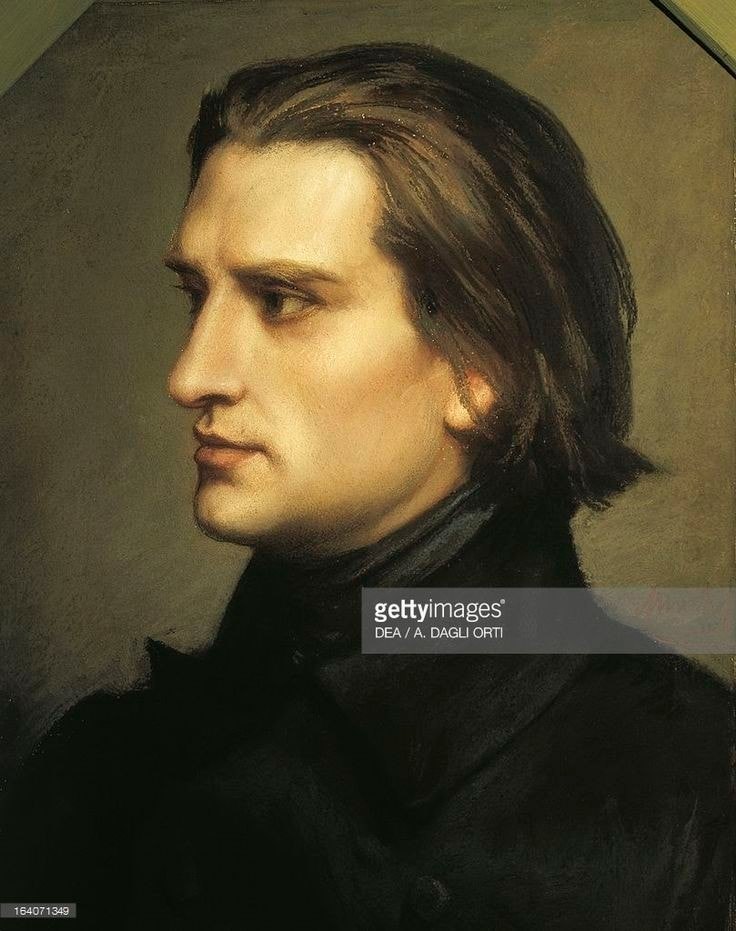
    Oil portrait of Liszt painted in 1840. His face is turned toward his right. He wars a black coat and a grey scarf. We can see his shoulders and his head.

    Story behind:

    Comment 1:

    This portrait was painted by Charles Laurent Maréchal, who was French painter, in 1840. Liszt was drawn and painted a lot during this period. Famous portraits known are those of Ary Scheffer in 1837, Josef Kriehuber and Friedrich von Amerling in 1838, Henri Lehmann and Ingres in 1839, and the famous painting by Josef Danhauser representing Liszt at the piano surrounded by his friends, in front of Beethoven’s bust, painted in 1840. The same year, 1840, Maréchal painted this pastel portrait of Liszt in Paris, along with other pastel works on Bohemian and Hungarian topics. This portrait is in the collection of the Richard-Wagner-Museum in Bayreuth.

    Comment 2:

    I forgot the source of the quote 🙂  Those who recognize me start to know me now 😂

    This quote is taken from Liszt’s book called “The Gypsy in Music” (original title in French: “Des Bohémiens et de leur musique en Hongrie”) published in 1859. The quote goes on. It says: “In Hungary all native music, in its origin, is divided naturally into melody destined for song or melody for the dance; there is so great a resemblance that it might almost be called identity of character.” There was a polemic about this book: in the way Liszt defined what he called Gypsy Music, he used the terms “Hungarian music” and “Gypsy music” almost as synonyms, which can be discussed. However, for us musicologists (and I believe, also for ethnomusicologists), this book is a great source, musically, technically, and on the vision of the musical characters Liszt was describing.

  • “Story Behind” Series #6 – May 5, 2021

    Published on Franz Liszt Group, on May 5, 2021. If you want to know how the Story Behind series started, I give details in “Story Behind” Series #1″.


    Background and original post:

    A group member wanted to share a colorized picture of Liszt he worked on. I asked him if he would like me to give the story behind the picture. He said yes.

    I wanted to share with you this photograph of Liszt (ca. 1880), which I colorized myself 🙂

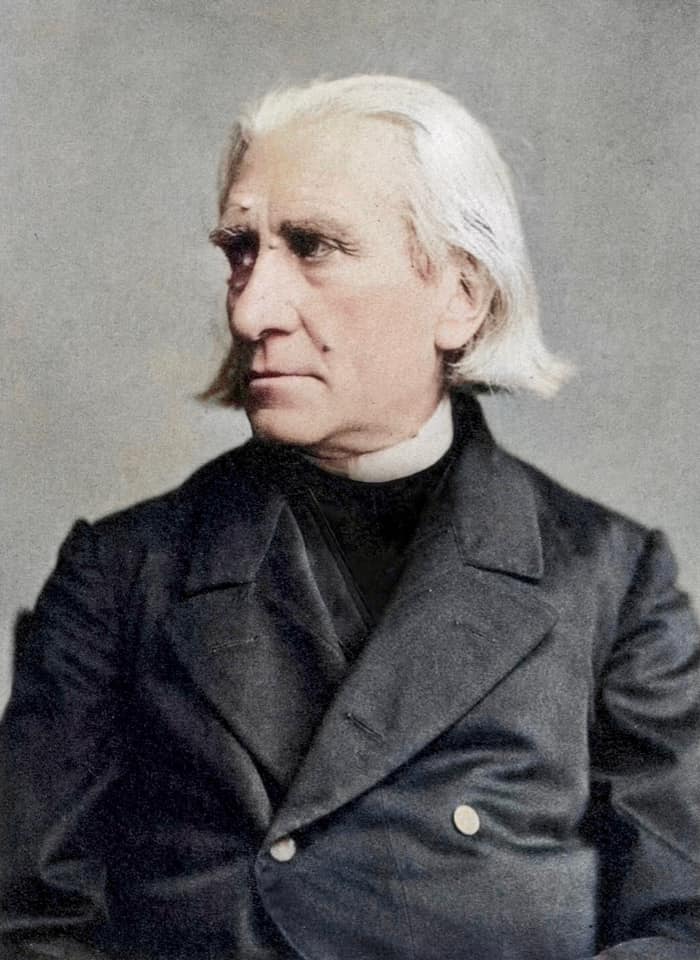
    Colorized portait of Liszt. The original picture was black and white and was taken in 1876. Liszt wears a cassock and a coat. He looks on his right.
    Portrait of Liszt colorized par Jorge Modolell

    Story behind:

    Thank you [name of the group member], that’s great 🙂

    Story time for those who are interested. Here is the background behind this picture. This picture was taken by the photographer Friedrich Hertel in Weimar in July 1876. It comes from a series, and Liszt is smiling on almost all of them, which is worth noting, knowing that this is rare 🙂

    At the period it was taken, Liszt was doing his usual trips between Rome (actually the Villa d’Este, but he didn’t compose his Jeux d’Eaux until the following year, 1877), Budapest (where he opened the new Academy of Music earlier the same year, in February 1876) and Weimar. Just after the picture was taken, he left for Bayreuth to join the Wagners. This is also the year where Wagner praised Liszt during a banquet in Bayreuth, saying that nobody would have heard of him if Liszt didn’t promote his music. 1876 is the year he started to draft his Via Crucis.

  • “Story Behind” Series #5 – April 27, 2021

    Published on Franz Liszt Group, on April 27, 2021. If you want to know how the Story Behind series started, I give details in “Story Behind” Series #1″.


    Original post:

    No quote, just the picture and the following mention:

    Franz Liszt, Paris, 1866 (Pierre Petit)

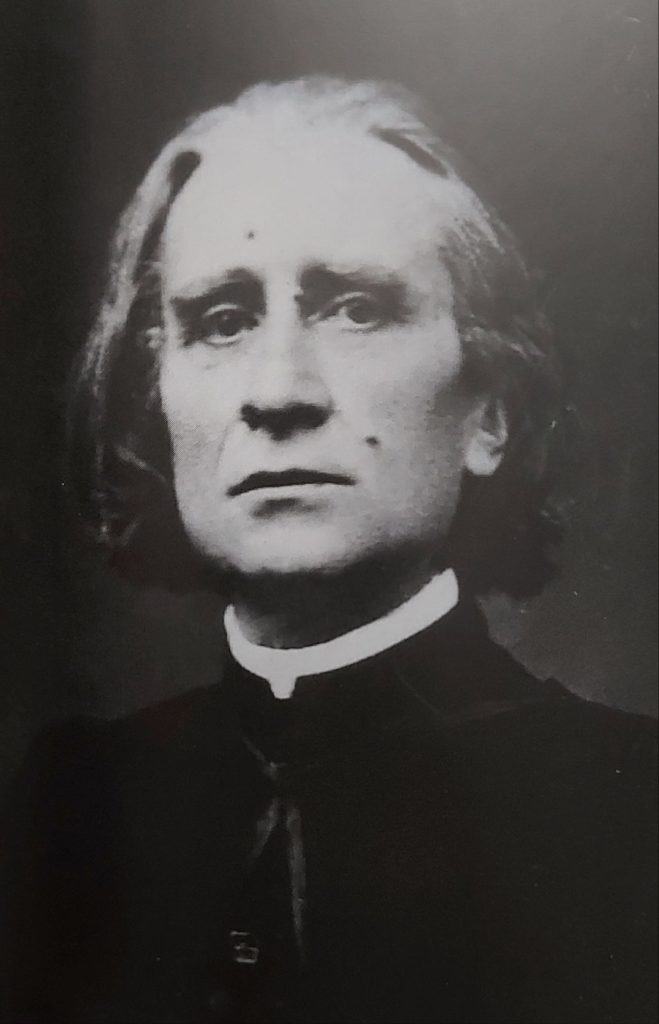
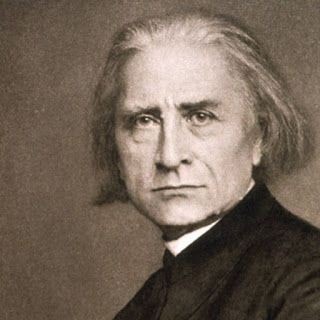
    Picture in black and white taken in 1866. Liszt wears a cassock and looks at the camera with a serious face. Only his shoulders and his head can be seen.

    Story behind:

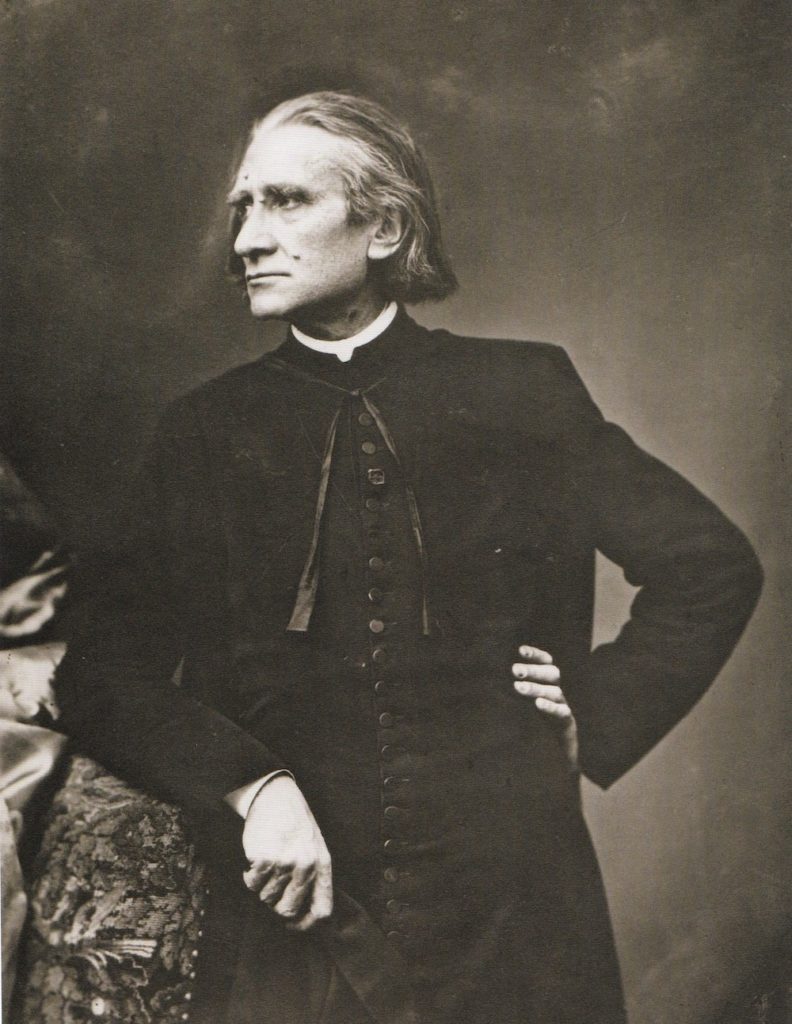
    For those who are interested, here is the story behind this picture. In March 1866, Liszt was in Paris. He allowed three photographers to take some pictures of him in their respective studios: Ferdinand Mulnier, Erwin Hanfstaengl (known as Erwin, brother of Franz Hanfstaengl and uncle of Edgar Hanfstaengl, who both also took pictures of Liszt) and Pierre Petit. I find the shots taken by Erwin and Pierre Petit quite similar, but Liszt looks very serious (as usual) in the shots taken by Erwin and a bit more relaxed in the ones taken by Pierre Petit. Both took series of pictures, and in the few that we know, Pierre Petit succeeded in taking this one that we see right now, in which he is looking at the camera. He is usually looking right or left but never in the photographer’s direction. As for the relaxed position, here is another photograph taken by Pierre Petit in the same 1866 series. That’s what I mean by “a little more relaxed” 🙂

    Picture in black and white taken in 1866. Liszt wears a cassock. His head is turned to the right. His left hand is on his hip and his right arm leans on a table.
  • “Story Behind” Series #4 – April 27, 2021

    Published on another Facebook group called FRANZ LISZT, on April 27, 2021. If you want to know how the Story Behind series started, I give details in “Story Behind” Series #1″.


    Background:

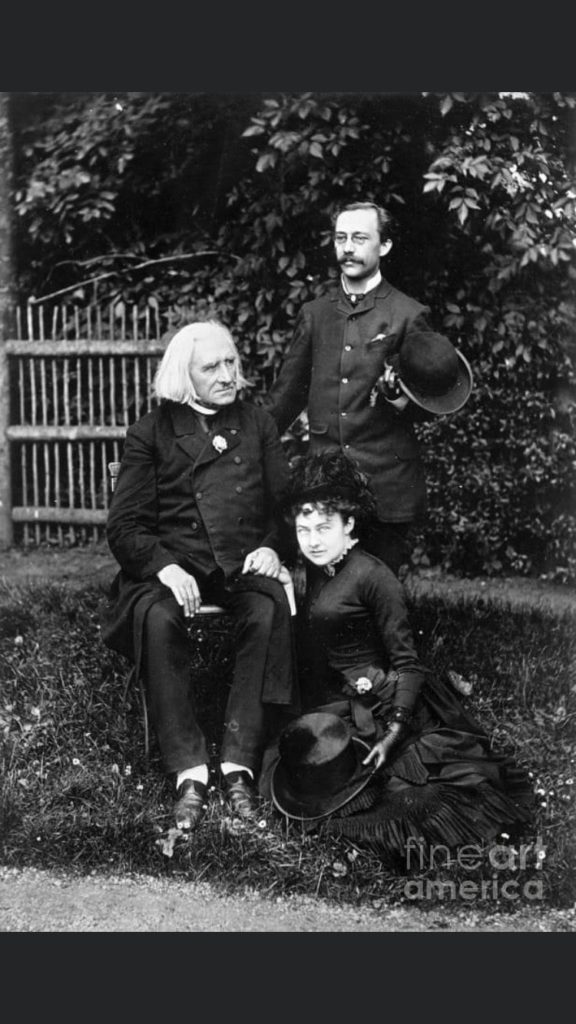
    No quote, but this picture was posted and some group members commented: they thought it was a picture of Liszt with his daughter Cosima and Hans von Bülow who was Cosima’s first husband before she married Wagner. This is not the case.

    Picture in black and white taken in 1884, showing Liszt sitting in his garden, wearing a black coat. His pupil Carl Lachmund is standing behind him, and Caroline Lachmund, Carl's wife, is sitting on the grass on Liszt's right. Liszt is holding Caroline's hand. Carl and Caroline wear black jackets and hold their hats.

    Story behind:

    Hello all. This is not a picture representing Cosima, and the man is not Hans von Bülow. It represents his pupil Carl Lachmund and his wife Caroline (nickname: Carrie – this is how she was signing her letters to her friends and family members). Lachmund was a late pupil of Liszt. He attended his masterclasses in Weimar from 1882 to 1884. They became friends, and Liszt allowed Caroline to become a guest to the lessons, which was a great privilege. Carl and Caroline were American. Liszt didn’t particularly like the English language but he appreciated the roaster of American pupils, who were always full of joy and surprises, organizing parties with American songs and compositions of their own. The Master was always invited. This picture was taken by Louis Held in 1884, shortly before the couple left Weimar. Liszt used to go for daily walks in the park just behind his house (he was living in the Hofgärtnerei, which means House of the Gardner). This particular day of June 1884, he proposed to the couple to join him in his walk. Louis Held, who was spending hours in the Hofgärtnerei to take pictures of Liszt with his pupils, suggested to take one of the three friends. The details of the friendship between Carl Lachmund et Franz Liszt are available in the book “Living with Liszt, Diary of Carl Lachmund, an American Pupil of Liszt, 1882-1884”. As for Cosima, she was not close to her father, and definitely not tender.* They were never very close, it can be seen in the numerous letters they exchanged. Cosima felt that he was always absent, from her childhood to her young adulthood. Some would argue that she married Hans von Bülow, who was one of the favorite pupils of Liszt, only to get closer to his father. When she dated and then later married Wagner, Liszt refused to see his daughter and his friend Richard for many months. And the story of the end of Liszt’s life is also poignant. Cosima literally abandoned his sick father and forbade some of his close friends to visit the dying man. For those interested, the book “The Death of Franz Liszt, based on the Unpublished Diary of his Pupil Lina Schmalhausen” is relating the ten last days of the Master. I was in shock when I read it for the first time and still am today.

    * I was reacting to a comment saying that it was touching to see the tender relationship between Cosima and her father.

  • “Story Behind” Series #3 – April 26, 2021

    Published on Franz Liszt Group, April 26, 2021. If you want to know how the Story Behind series started, I give details in “Story Behind” Series #1″.


    Original post:

    So let us not worry, and look instead as it has been taught us to do, as the birds of the air and the lilies of the field, keeping complete faith in Our Father’s goodness.
    Franz Liszt

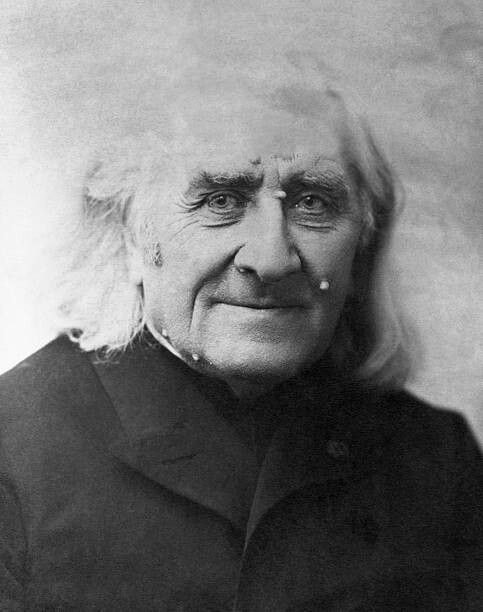
    Picture in black and white taken in 1885, showing Liszt wearing a black coat. He has long white hair. He is facing the camera and smiling.

    Story behind:

    Here are the sources: the quote is from a letter Liszt wrote to Marie zu Sayn-Wittgenstein, the daughter of his partner Carolyne, from Rome in February 18, 1870. The picture was taken by Louis Held in 1885, and is part of a series of pictures Mr Held took of Liszt and his pupils in the Hofgärtnerei, his home in Weimar, where he received students attending his famous masterclasses. In the same series, there is also a famous portrait of Liszt sitting at his desk in his living-room. Today, when you visit the Liszt-Haus in Weimar, the same curtains and furnitures are still there, making the place alive. There is still his Bechstein Grand piano (although someone told me that the sound is not that great anymore as it is barely maintained, which would certainly sadden the Master if he knew about it). Amazing fact: there are not a lot of pictures in which we can see Liszt smiling. Both Louis Held and Nadar, who photographied Liszt numerous times between 1884 and 1886, succeeded in making Liszt smile 🙂

    (Note: I was contacted by someone who wanted a copy of the original letter, which I happened to have, for an academic work. I like it when these posts can help others.)

  • Liszt Animated Pictures – 1866 1874

    A new Liszt video with the new AI algorithm. I treated period 1866 to 1874. The difference is that I added the original pictures for you to see the original source.

    Link to this YouTube video if needed: https://youtu.be/1L4qppj2sUs

    Other Liszt videos:
    Animated pictures & portraits: https://youtu.be/GY_KFV0ldJ0​
    Animated Pictures – 1858 1866: https://youtu.be/S3HQ5XeHH1M
    Animated Pictures – 1876 1886: https://youtu.be/C0T4mbNZYpI
    Animated Paintings and Drawings – 1824 1886: https://youtu.be/c1EU93j335c

    Beethoven video:
    https://youtu.be/Pfr1IhCqwgA

  • Early Metronome Markings and the “A Tempo Project” – Journal of the American Liszt Society – Volume 70-71 2019-2020

    Abstract:

    The topic of early metronome markings has always been a long-standing puzzle for musicians and scholars. Conductors and performers face the difficult task of interpreting tempi indications of works of the nineteenth century, with metronome markings that occasionally seem incorrect according to our modern standards. The “A Tempo Project,” a video project by Swiss pianist, composer, and organist Bernhard Ruchti, includes useful analyses of scores and musicological sources such as historical performance reviews, correspondence, original manuscript notations, and recordings of the studied works. Ruchti illustrates how different readings of tempi indications have impacted historical performance and attempts to explain the wide range of metronome marking interpretations. Taken as a whole, Ruchti’s work helps shed light on the complicated and ever-timely problem of historical metronome markings.

    Publication:
    Journal of the American Liszt Society
    Volume 70-71 2019-2020 – April 2021

    Link to the article on ResearchGate:
    https://www.researchgate.net/publication/350954569_Early_Metronome_Markings_and_the_A_Tempo_Project_-Journal_of_the_American_Liszt_Society-_Volume_70-71_2019-2020

  • “Story Behind” Series #2 – April 15, 2021

    Published on Franz Liszt Group, April 15, 2021. If you want to know how the Story Behind series started, I give details in “Story Behind” Series #1″.


    Original post:

    In life one must decide whether to conjugate the verb to have or the verb to be.
    Liszt

    Picture in black and white taken in 1867, showing Liszt wearing a suit. Only his head and shoulders can be seen. His face looks serious.

    Story behind, and conversation:

    Group member:
    Do you know the source of this quote?

    Diane Kolin:
    It appears in Cosima Wagner’s book about his father, called “Franz Liszt: Ein Gedenkblatt von seiner Tochter” published in 1911.

    Story time 🙂  The picture we see here, a pretty famous one, was taken in October 1867 by the photographer Franz Hanfstaengl. It is incomplete, though. The full picture represents Liszt sitting in a wooden armchair and holding a handkerchief. It was taken in Munich, during a trip from Rome to Lucerne. Liszt was a constant traveler. Where it relates to the quote posted, is that at the time this picture was taken, Liszt was going to Lucerne to meet with Cosima and face the Wagner & Cosima relationship for the first time. Long story short, he already knew about it as it was a great scandal at the time, ongoing since 1864 while Cosima was still married to one of Liszt’s favorite pupils, Hans von Bülow. Liszt was angry with his daughter after he discovered the love affair and decided not to talk to Cosima and Richard for quite a long time. He wrote to Cosima to express his disappointment. But it had to wait until October 1867 for them to meet again, and to reconcile. This picture was taken in Munich in October 1867, just before going to Lucerne. Interestingly, the quote is given by Cosima in her book about her father. When we know the relationship between the two, it is hard to know if he really said it or not. But I agree, it is a great quote, and Liszt definitely could have said this 🙂 

    (Note: It was after that conversation that I realized I was not the only person interested in sources on this group.)

  • “‘Ad nos, ad salutarem undam’ by Franz Liszt… The most powerful work ever heard on the organ…” – liszt-franz.com

    Article in French.

    Introduction to the article on the liszt-franz.com website:

    This article is about Bernhard Ruchti’s book “‘Ad nos, ad salutarem undam’ by Franz Liszt… The most powerful work ever heard on the organ…’, Ad nos as an open door to the discovery of hidden performance practices of the nineteenth century.” With his skills at the organ, the musicologist, pianist and composer Bernhard Ruchti subtly dives into Liszt’s masterpiece, composed in 1850 in Weimar, known and appreciated by by all organists. Diane Kolin, resident of Canada, eclectic musicologist and music lover, is passionate about Beethoven and Liszt. In this article she presents Bernhard Ruchti’s book. Unfortuanetly, only the German speakers will be able to read it. For the others, a translation would be most welcome.

    Note:
    My contribution to this book consisted in proofreading, particularly all excerpts in French, and the suggestion of a new section bringing the score of Ad nos and the important comments made by Bernhard Ruchti closer. As a musicologist, I like to follow the score of a studied piece. I proposed a musical analysis section in the form of a table integrating measure numbers, temporal markers from the CD of Ad nos recorded by Ruchti, and the key comments. This section has been added to the book.

    Publication liszt-franz.com
    April 2021
    https://www.liszt-franz.com/musicologie

    Link to the article on ResearchGate:
    https://www.researchgate.net/publication/350735641_Les_Ad_nos_ad_salutarem_de_Franz_Liszt_L’oeuvre_la_plus_puissante_jamais_entendue_a_l’orgue

    Presentation of the book by the author:
    https://youtu.be/lPZlDrNVSL4

    Buy the book (in German):
    “… das Gewaltigste, was ich je auf der Orgel gehört habe”: Franz Liszts Ad Nos als Tor zur Wiederentdeckung einer verborgenen Aufführungspraxis des 19. Jahrhunderts
    https://www.amazon.de/dp/3826072421/ref=cm_sw_em_r_mt_dp_1DV1NCR6ARGH93WR3SXN

    More information about Bernhard Ruchti (in English and German):
    https://www.bernhardruchti.com/