The second show I recorded in September about Franz Liszt for the French radio Fréquence Protestante has been published. The show is called “In the footsteps of Liszt” (“Dans les pas de Liszt”) and is animated by Paul-Hubert des Mesnards and Catherine Gras.
The episode is in French. For this second show I presented some of Liszt’s students, their testimonies, and even some recordings. It was published on January 4, 2025. You can listen to the episode below.
In September, I recorded two shows about Franz Liszt for the French radio Fréquence Protestante. The show is called “In the footsteps of Liszt” (“Dans les pas de Liszt”) and is animated by Paul-Hubert des Mesnards and Catherine Gras.
The episode is in French. I chose to speak about Liszt as a teacher and the impact on his students. The first part is about Liszt as a pedagogue. It was published on December 7, 2024. You can listen to the episode below.
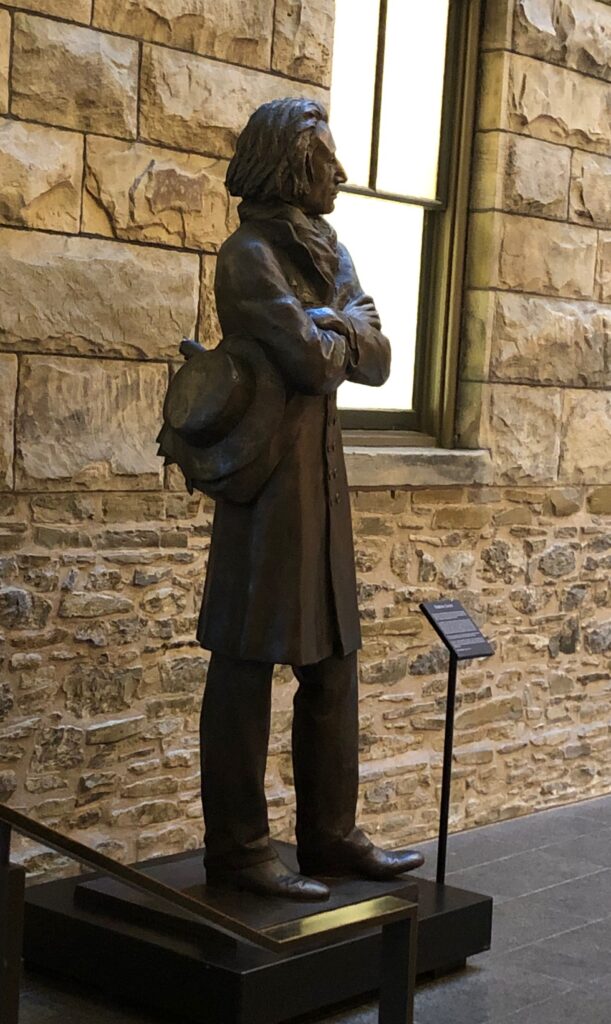
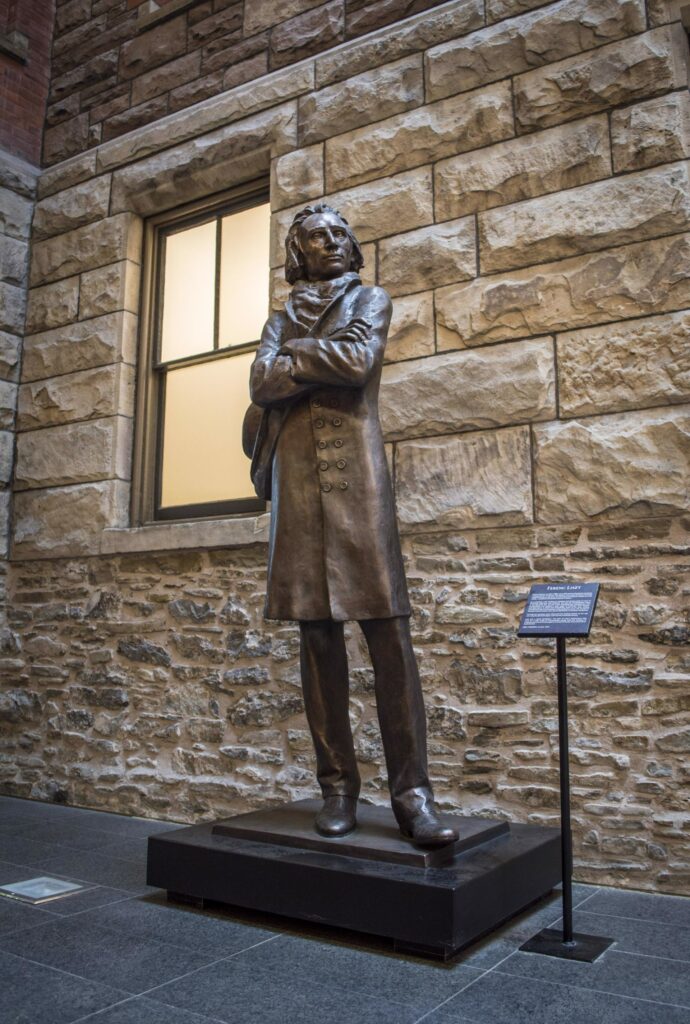
Since the summer is over, I wanted to publish a new “story behind” before my schedule gets too busy with my Fall 2022 activities. Instead of a story based on a photograph of Liszt, I propose the story behind a statue of Liszt, which can be seen where I live, in the city of Toronto in Canada.
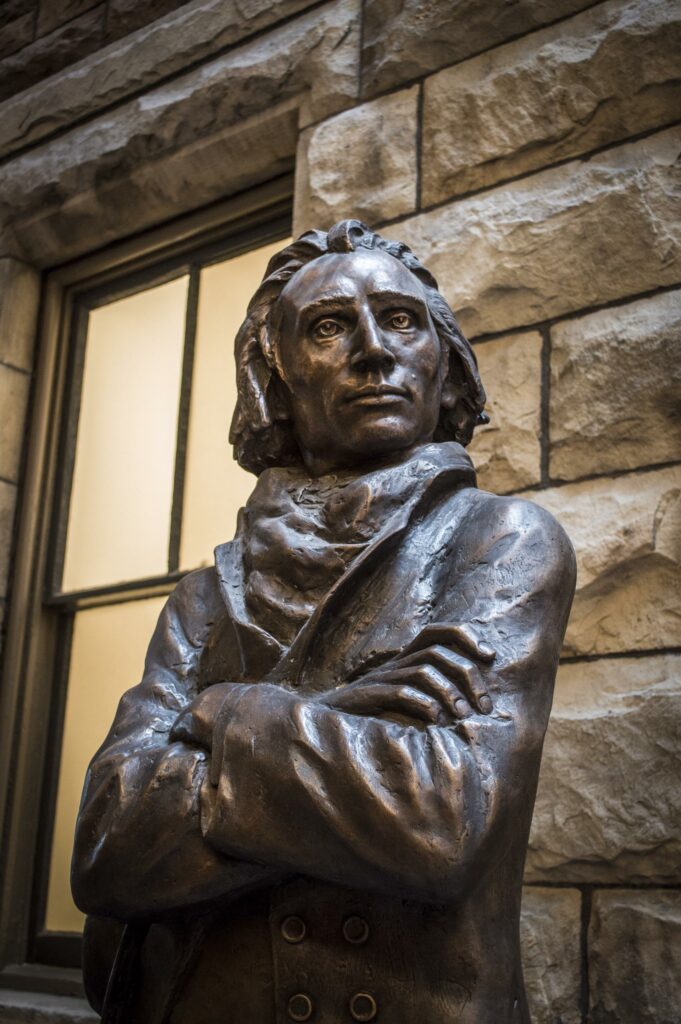
Recently, I was at Toronto’s famous concert hall, Koerner Hall, part of the Royal Conservatory of Music (now called Oscar Peterson School of Music), for a rehearsal. Somewhere in the building, a statue of Liszt can be admired. I posted pictures on social media. Intrigued, some of my Lisztian friends in France asked for more details.
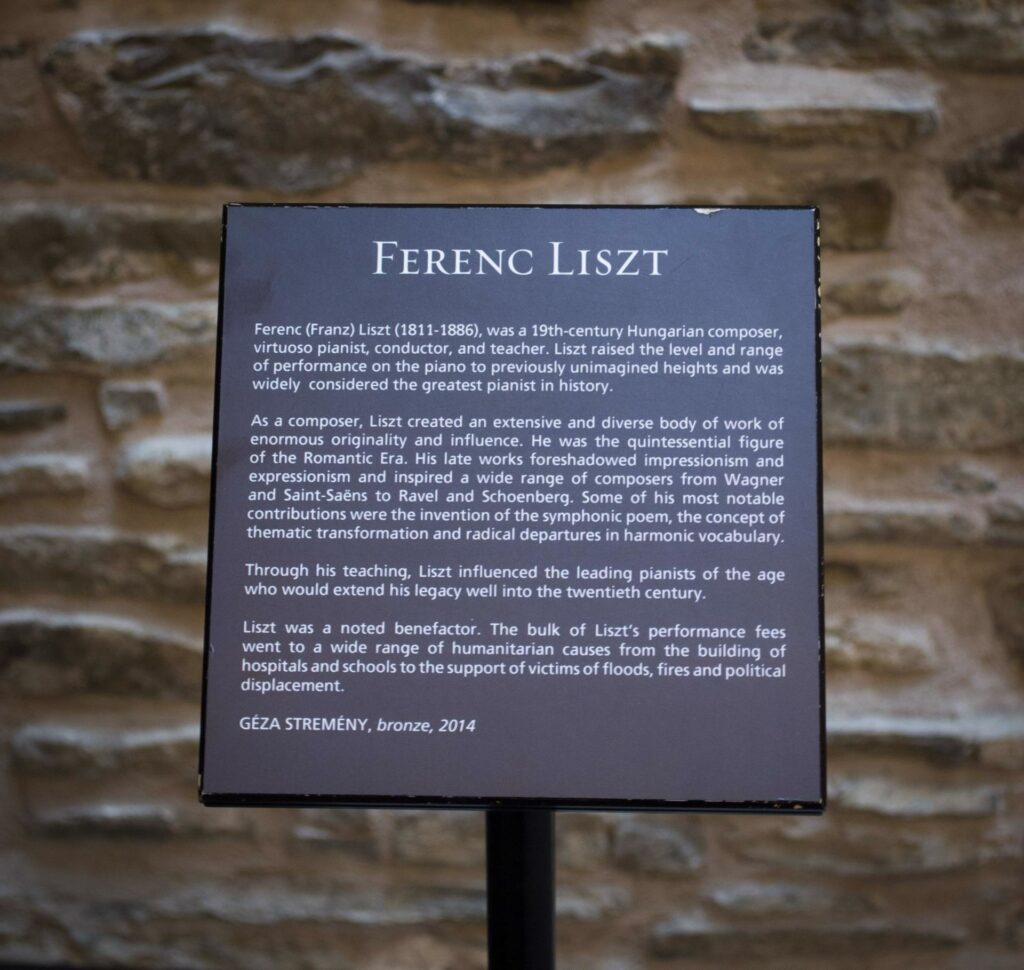
This statue is a 7 feet (2.25m) tall sculpture. It was offered to the Royal Conservatory of Music in 2014 by the Canadian-Hungarian donor Tamás Fekete, who also made a gift of a bronze statue of Béla Bartók to the school a few years before. The Liszt sculpture was commissioned to a Hungarian artist, Géza Stremeny, who is famous for his statues of Hungarian Prime Minister Count István Bethlen in Buda Castle and Count Lajos Batthyány, head of the country’s first government, on the Budapest square bearing his name. The Liszt statue was transported to Canada by air, where it was unveiled in the Conservatory building. At the ceremony one of the speakers was the Canadian Liszt expert Alan Walker, known for his very complete biography of Franz Liszt in three volumes. (1)
The Royal Conservatory of Music, first called Toronto Conservatory of Music was founded in 1886, the year Liszt died. Dr. Peter Simon, who was appointed President of The Royal Conservatory in September 1991 and is still CEO of the school today, is a Hungarian-born Canadian.
In his biography, Alan Walker tells the story of a portrait of Liszt that made his way to Toronto as a gift from the composer to the piano factory Mason & Risch. I reproduce here the full excerpt (2):
Paul von Joukowsky (…), who was still basking in praise for his stage designs for Parsifal, had followed Liszt from Bayreuth [in 1882] in order to paint his portrait. The picture had been commissioned by Liszt himself as a gift to the piano manufacturer Vincent Risch, who had recently met Liszt and had presented him with one of the first grand pianos made by his Toronto-based firm, Mason and Risch.
Note 16: Although the firm of Mason and Risch had long been making upright and square pianos, they had never made grands. At Liszt’s encouragement they produced their first model in April 1882. Risch was delighted with the result, and he told Liszt that it was notable for its richness, breadth, and power. When Liszt expressed interest in testing the instrument, Risch sent him a second model, which was delivered to Weimar on September 19, 1882. After playing on it for more than two months, Liszt told Risch: “The Mason & Risch grand piano you forwarded to me is excellent, magnificent, unequalled. Artists, Judges, and the Public will certainly be of the same opinion.” (This letter, which is dated November 10, 1882, is reproduced in a Mason & Risch advertisement in the Toronto Globe for December 18, 1883.) Liszt eventually gave the instrument to Carl Gille. (See LL, pp. 156–57.)
Liszt had already granted Joukowsky a number of sittings. By the end of the year the picture was finished, and all who saw it were struck by its vivid likeness to the composer. Joukowsky was prevailed upon by Carl Alexander to make a copy for deposit in the Weimar art gallery, which necessitated a short delay before the original could be despatched to Toronto. When it arrived, Risch had it hung in his showrooms, where it generated intense local interest.
Note 17: The picture arrived in Toronto on September 5, 1883. Vincent Risch told Liszt: “For weeks Toronto society came in their thousands to our hall, with their hats off and as serious as if they were in church. Men come and gaze on those well-known, admired, and venerated features.… This portrait, so strikingly natural, established the talent of the artist, and makes us all feel that you, dear master, are in our midst; and Canada feels richer and happier at the thought of possessing you.…” (WFLR, pp. 189–90) See also Liszt’s letter on this topic to Risch. (LLB, vol. 2, p. 346) The firm of Mason and Risch continued to make capital out of the Liszt portrait for a number of years. At the Toronto Exhibition of 1887 their booth was dominated by the painting, given to them “in acknowledgement of the excellence of a pianoforte sent to [Liszt] at Weimar by these gentlemen.” (Toronto Daily Mail, September 10, 1887) The portrait remained in the Toronto showroom until after World War II, when the firm went into liquidation. Meanwhile, the painting has passed into private ownership in America. (It was often wrongly attributed to the Toronto Conservatory of Music, who were never its owners.) Fortunately, the firm of Alfred Krupp, in Essen, made a good likeness of the picture which has made its way into many of the Liszt iconographies (see BFL, p. 286). And what became of the second canvas that Joukowsky painted for the grand duke? This, too, found its way to Vincent Risch in Toronto, and was exhibited by him at the Colonial Exhibition in London in the summer of 1886. This painting, which is now in the possession of a private owner in southern Ontario, was only identified in 1993. (3)
An even more detailed report of 25 pages about the relationship between Liszt and the piano factory has been published by Geraldine Keeling in her chapter entitled “Liszt and Mason & Risch” in New Light on Liszt and His Music: Essays in Honor of Alan Walker’s 65th Birthday. (4) The article gives many details about the firm and the two men behind the name. More basic information can be found about Mason & Risch here:
(2) Alan Walker, Franz Liszt Volume 3: The final years, 1861-1886. Knopf, 1996. Chapter: Nuages gris. III.
(3) The acronyms used in the notes are the followings: BFL: Burger, Ernst. Franz Liszt: A Chronicle of His Life in Pictures and Documents. Translated by Stewart Spencer. Princeton, 1989. LL: Living with Liszt: The Diary of Carl Lachmund, an American pupil of Liszt, 1882–1884. Edited, annotated, and introduced by Alan Walker. Stuyvesant, N.Y., 1995. LLB: La Mara, ed. Franz Liszts Briefe. 8 vols. Leipzig, 1893–1905. 1: Von Paris bis Rom. 2: Von Rom bis ans Ende. 3: Briefe an eine Freundin. 4, 5, 6, 7: Briefe an die Fürstin Carolyne Sayn-Wittgenstein. 8: Neue Folge zu Band I und II. WFLR: Wohl, Janka. François Liszt: Recollections of a Compatriot. Translated by B. Peyton Ward. London, 1887.
(4) Michael Saffle and James Deaville, Analecta Lisztiana II: New Light on Liszt and His Music: Essays in Honor of Alan Walker’s 65th Birthday. Pendragon Press, 1997.
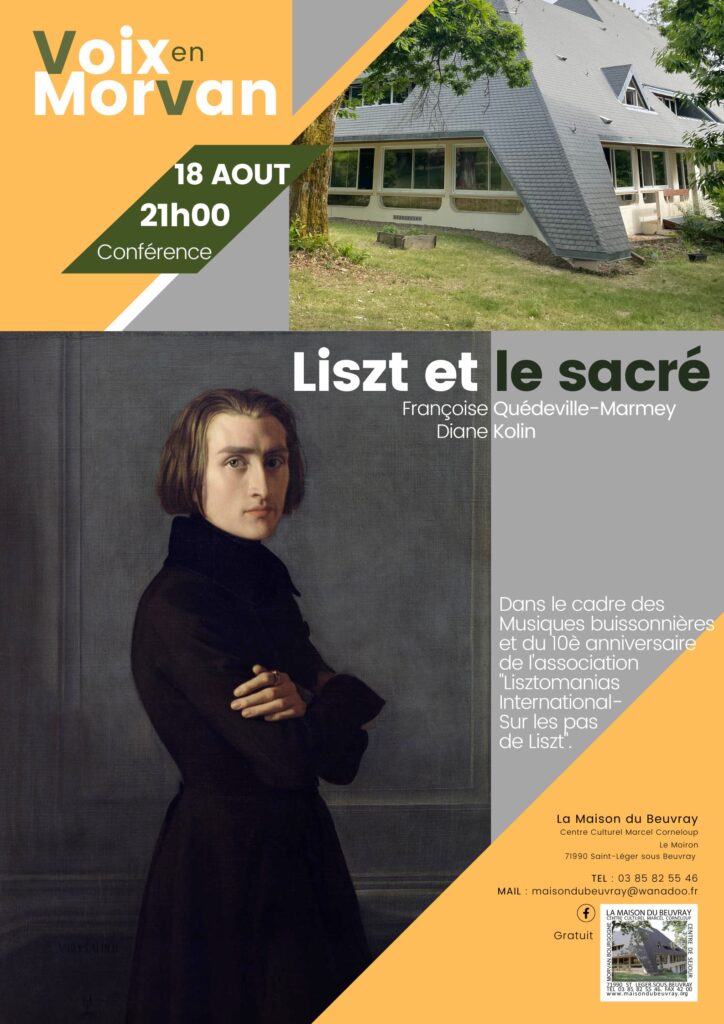
On August 18, 2022, I gave a conference about Liszt and Sacred Music with Françoise Quédeville-Marmey in the Morvan area in France, in Saint-Léger-sous-Beuvray. We shared the task, between biographical elements and musical examples. This conference was organized by the French Liszt Association, called “Sur les pas de Liszt”, in collaboration with the vocal workshop “Musiques Buissonnières” that happened during the week (August 13 to 19), with a concert on Friday night. The objective was for the participants to know Liszt’s vocal works, to discover a repertoire related to the composer, and to explore aspects of his life that are sometimes unknown.
Published on Franz Liszt Group, on June 3rd, 2022. If you want to know how the Story Behind series started, I give details in “Story Behind” Series #1″.
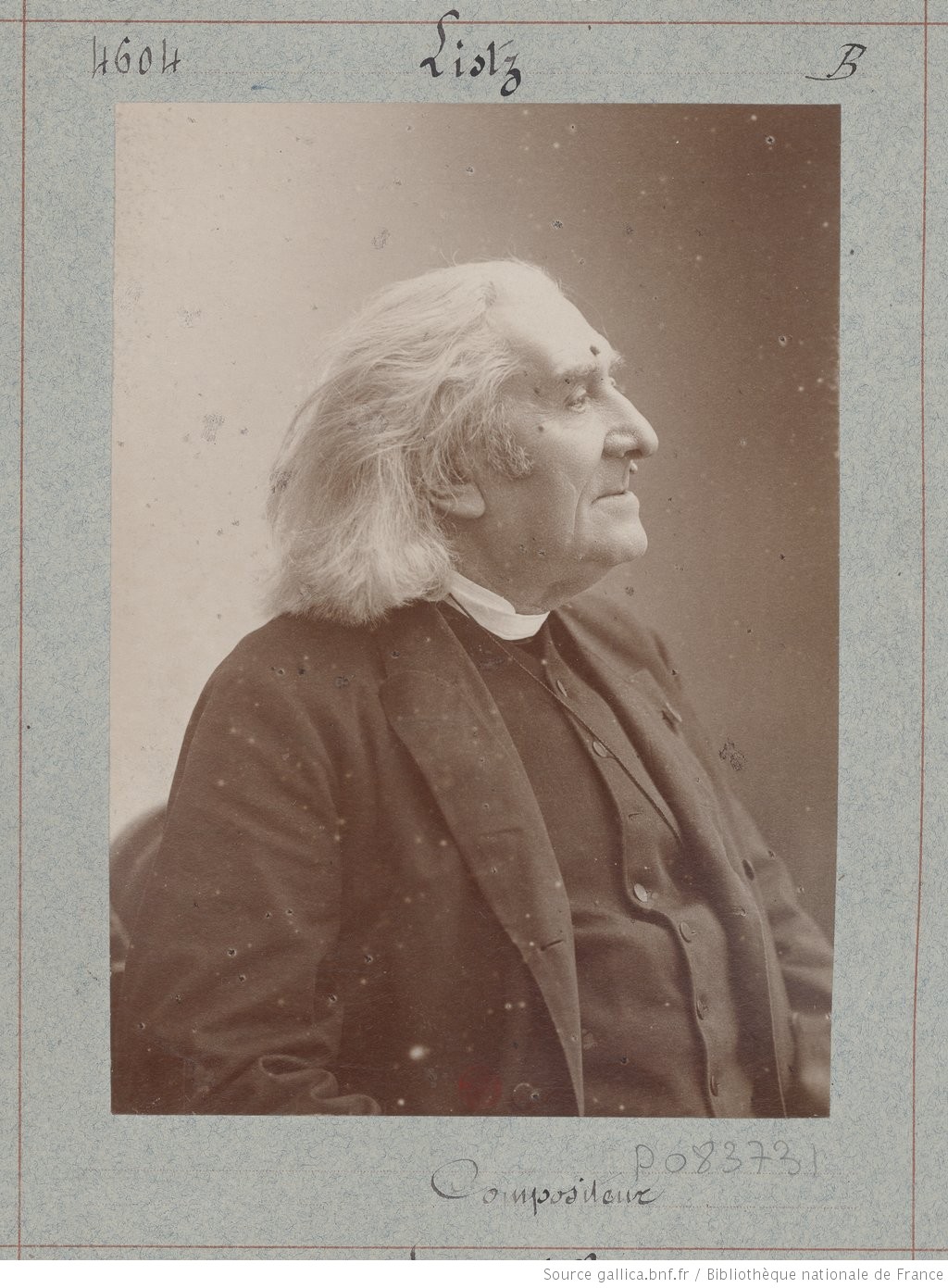
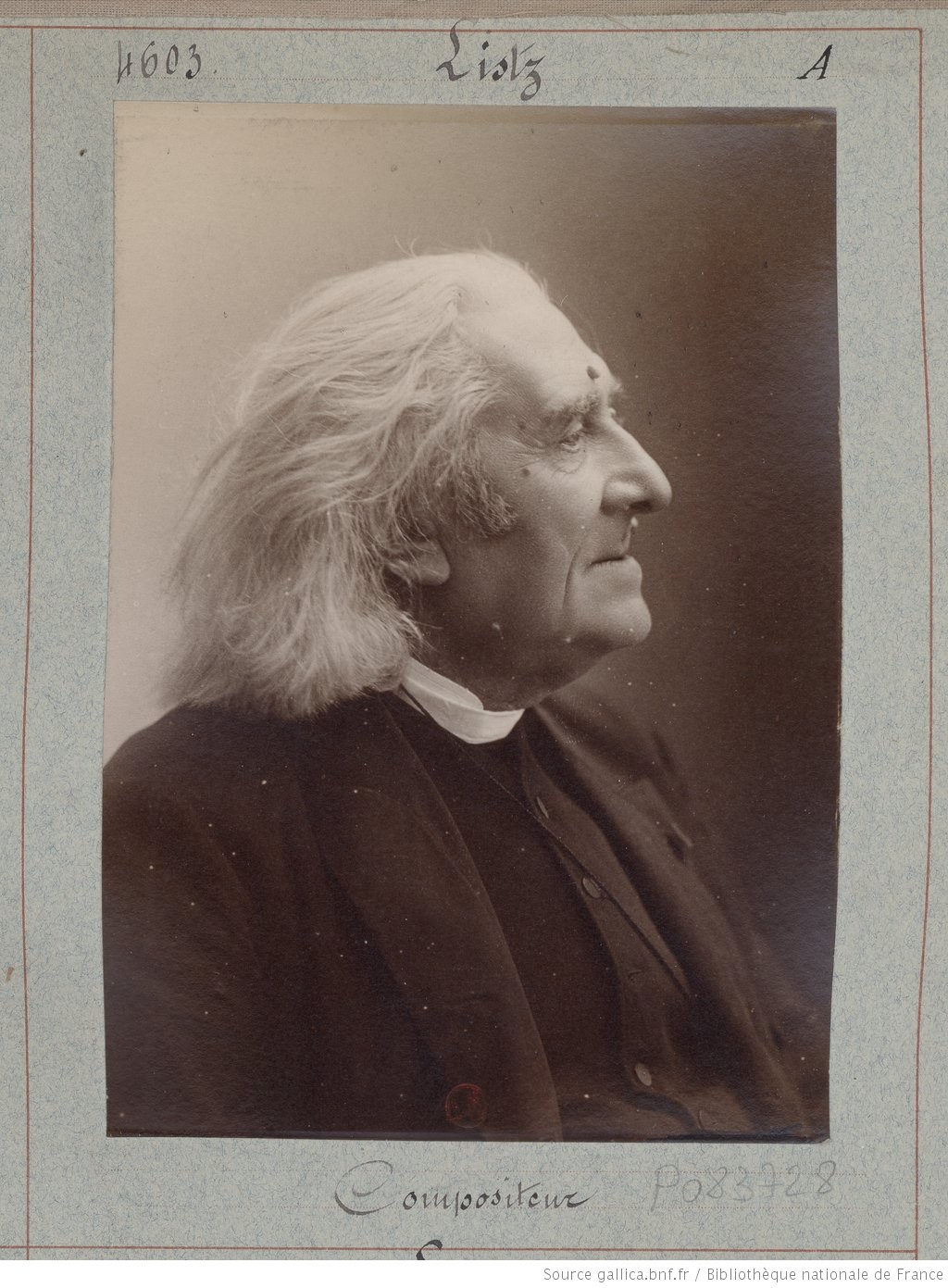
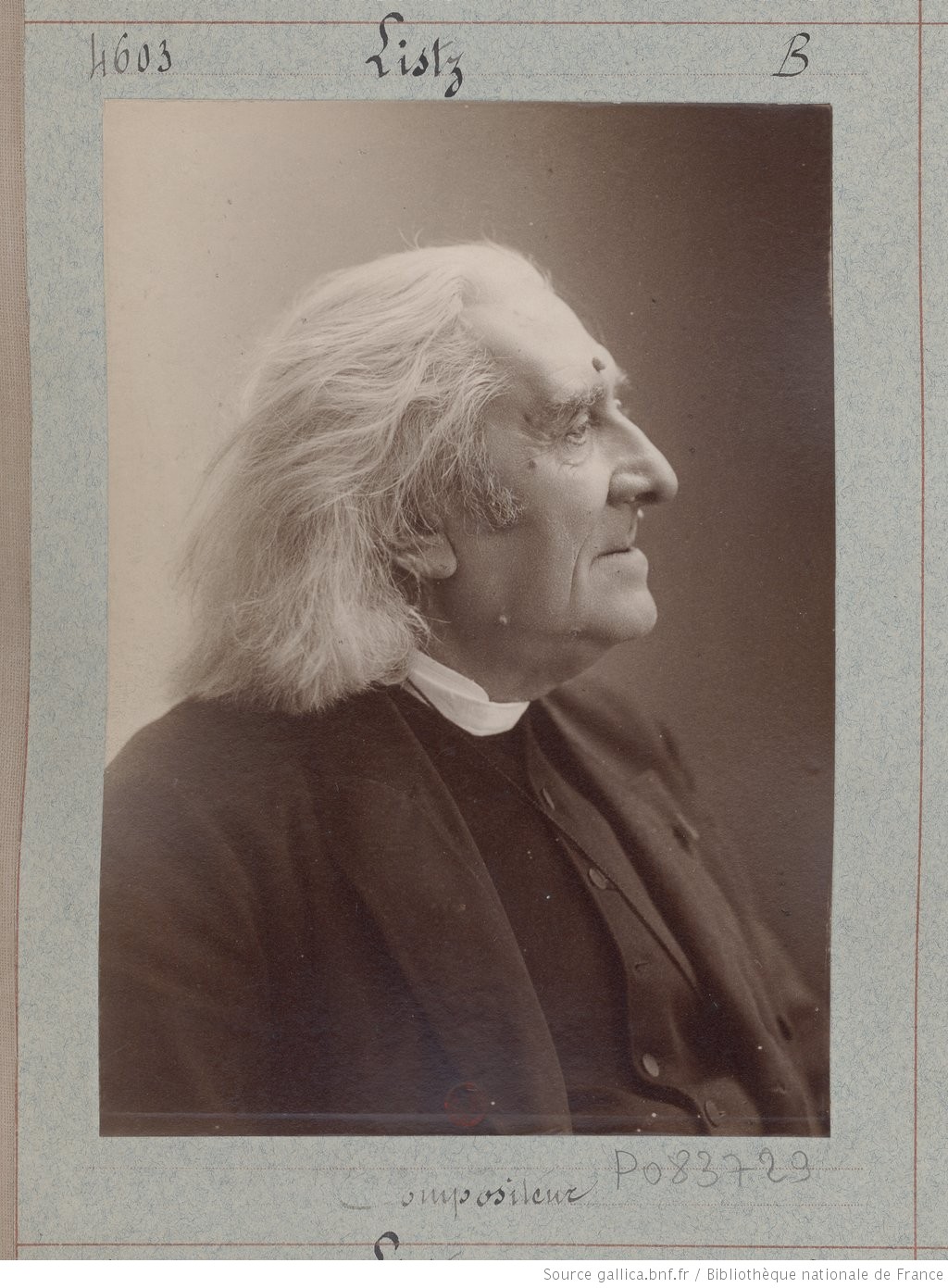
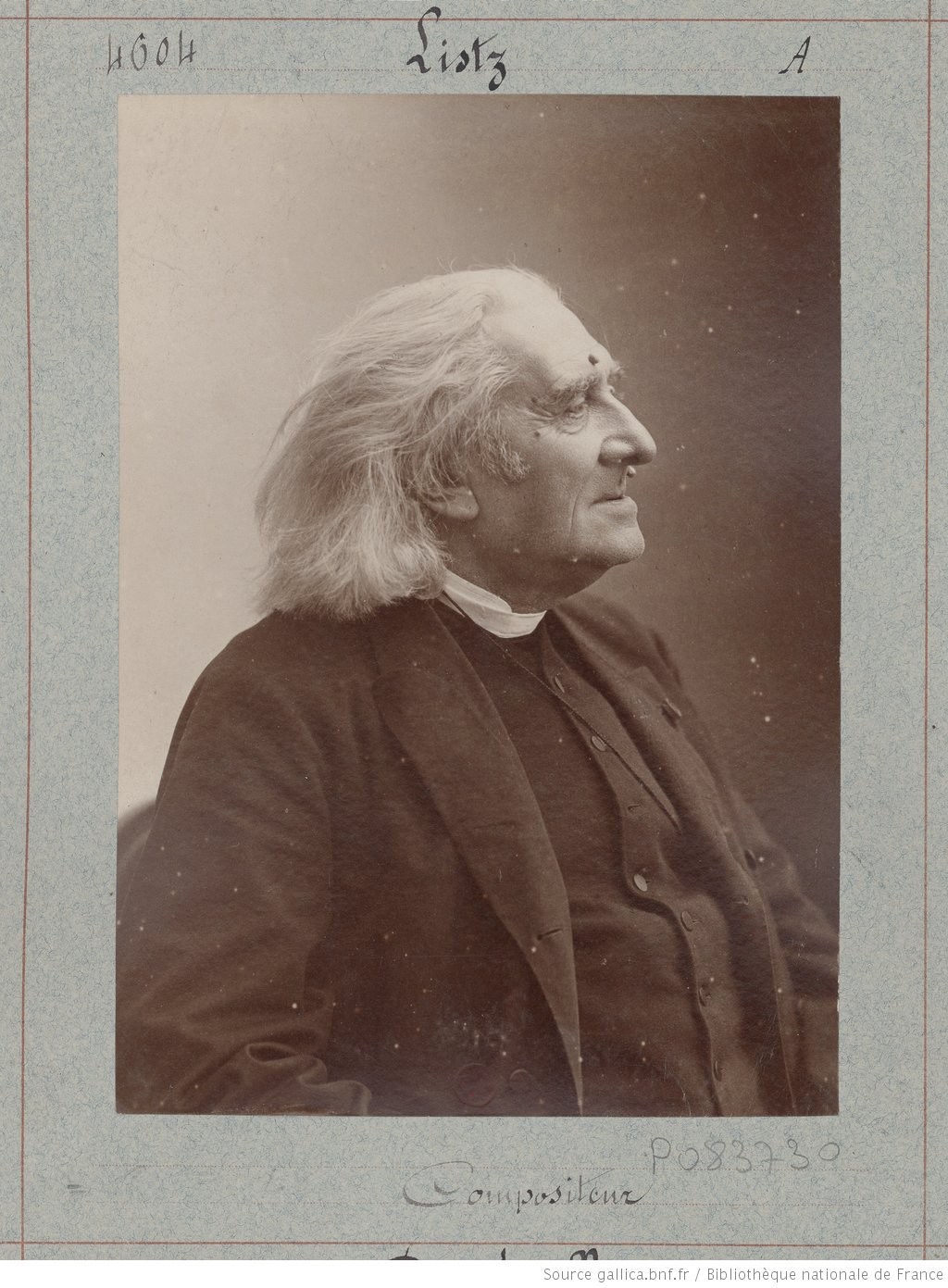
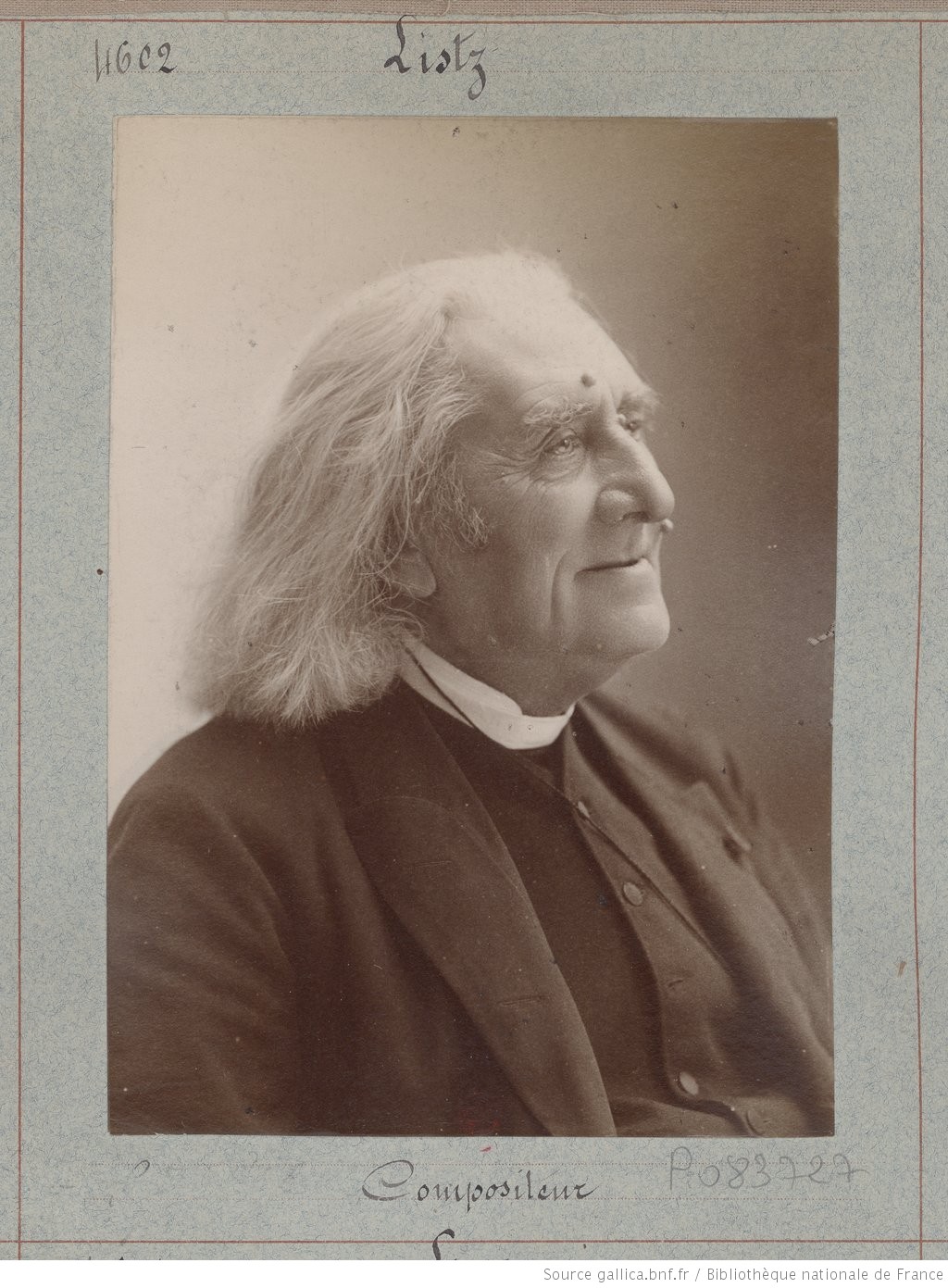
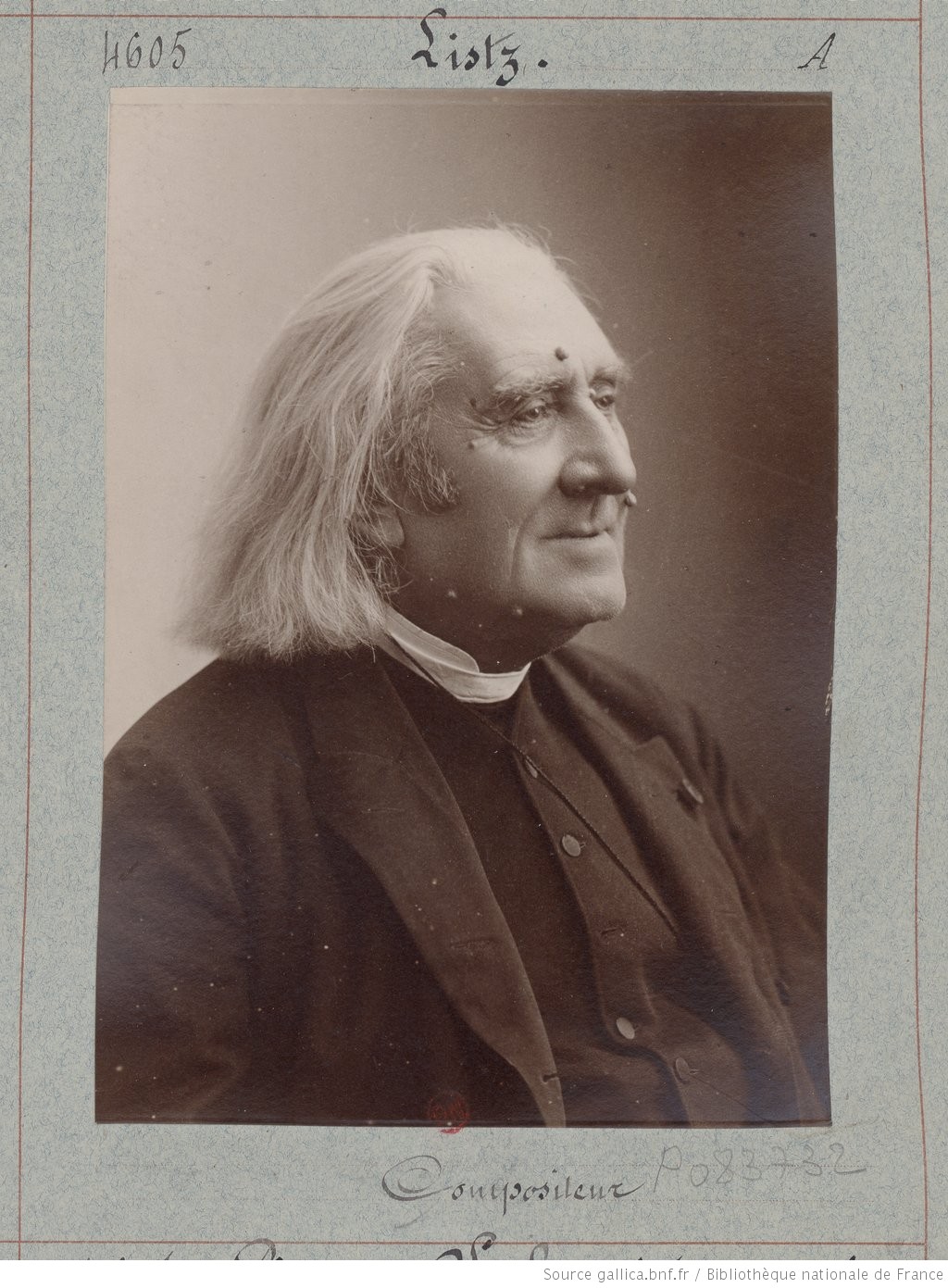
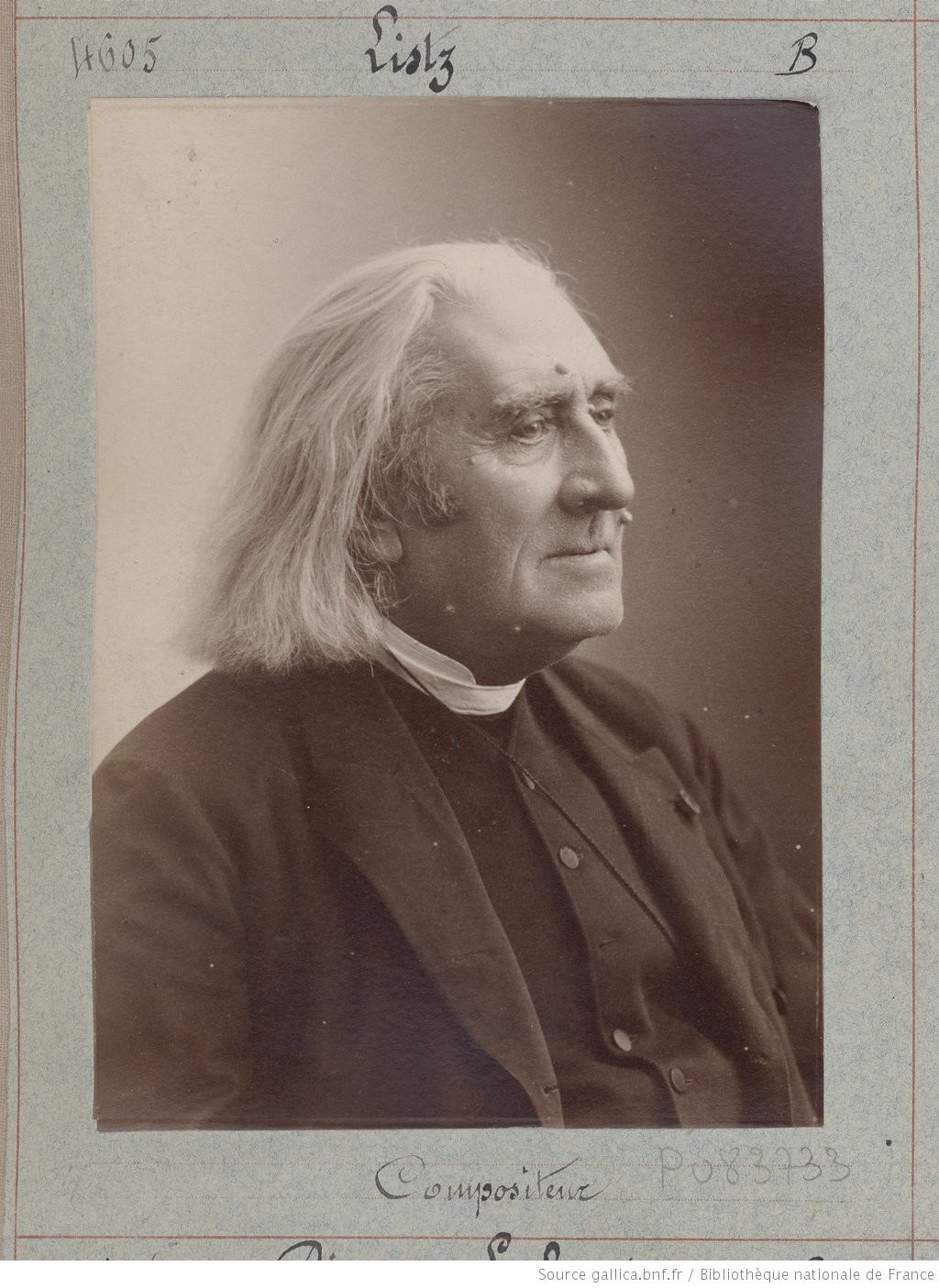
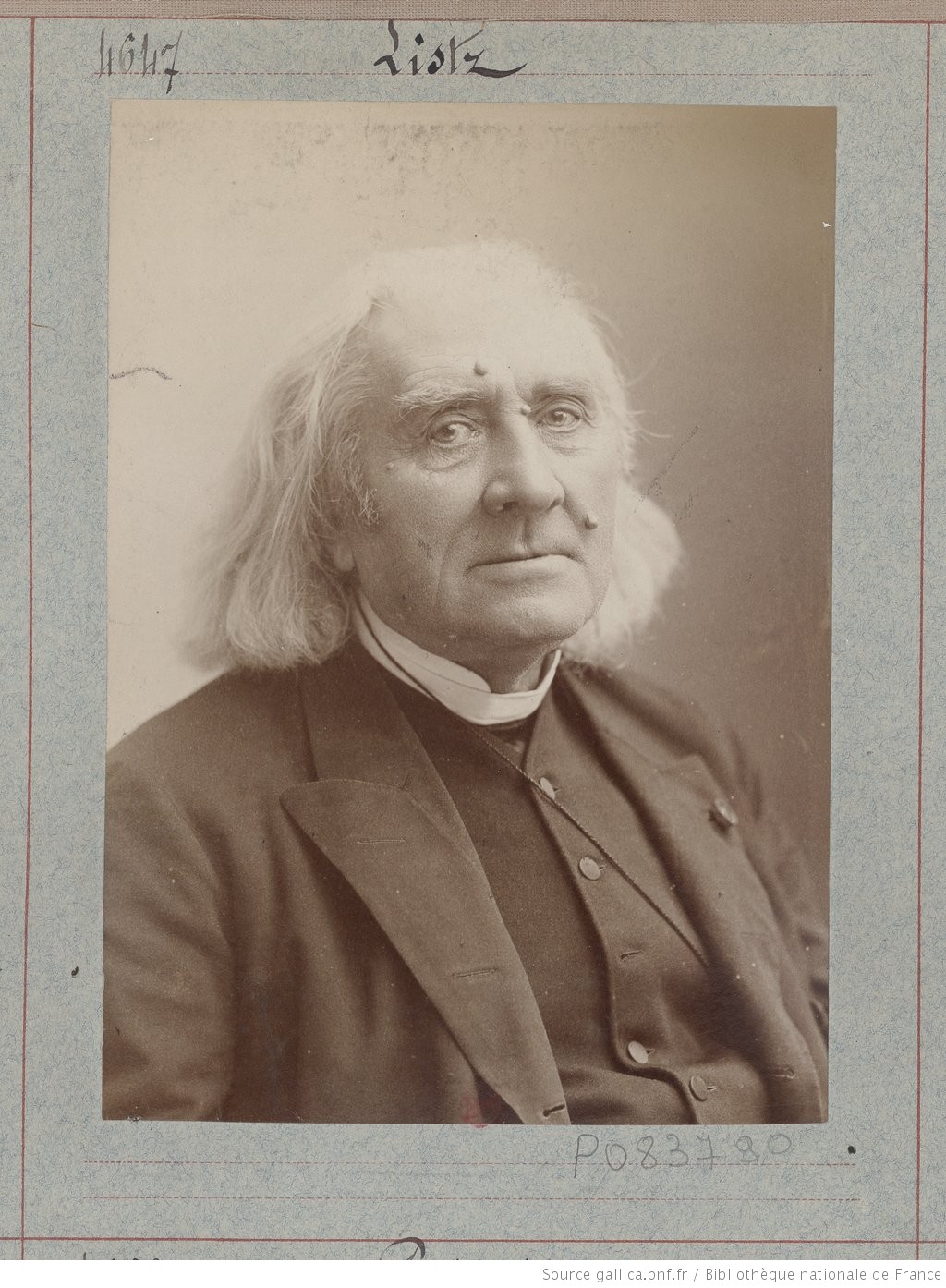
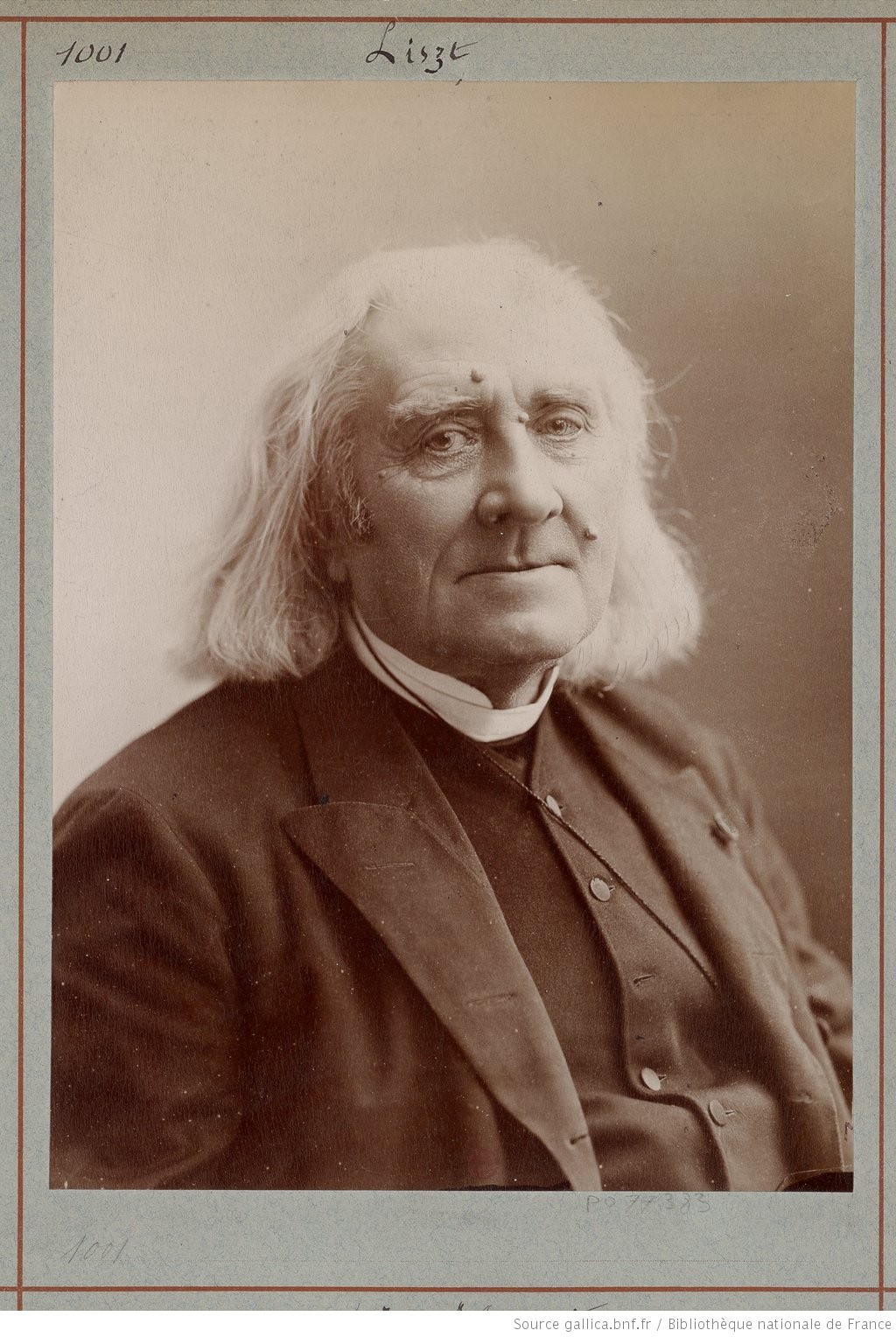
I am preparing my summer 2022 research trip. I will stop in Paris, Bonn, Weimar, and Budapest. Each archive has a lot of interesting pictures, and I was wondering which ones I could focus on for this new post. One of the last pictures of Liszt taken by Nadar is hanging on my wall. Liszt watches me. What I like about this picture is that he is half smiling, and depending on my mood or the way my day goes, I can see Liszt either reassuringly smiling at me, or looking at me with some concern. I already wrote about this last picture taken of Liszt by a professional photographer (“story behind” #21, post available here). While selecting the documents for my trip, I came across a digitalized version on the BnF website of the series taken by the talented Nadar in Paris in March 1886. Since these images are in the public domain, I thought you might enjoy seeing the whole series. I will associate each picture with its reference. The last picture is the one in which Liszt is looking at me right now.
A little bit more about Nadar (1820-1910). This Parisian photographer had several hats and lived a long life. His real name was Gaspard-Félix Tournachon. He started as a caricaturist and novelist (first publication in 1848). His pen name was Tournadar, which became Nadar. He quickly found interest in photography. Since he wanted to explore innovative techniques, he invented methods to take pictures from heights and in the dark. He became the first person to take aerial photographs from a hot-air balloon (first aerial picture in 1858), and developed artificial lights techniques to take pictures in the Paris catacombs (in 1861). He expanded his activities and became a renowned portraitist. His most famous portraits represent Charles Baudelaire, Sarah Bernhardt, Claude Debussy, Eugène Delacroix, Gustave Doré, Alexandre Dumas (father), Charles Gounod, Victor Hugo on his deathbed, Franz Liszt, George Sand, Jules Verne, Émile Zola. The list is non-exhaustive. If you want to know more about his life and work, I recommend his autobiography “When I Was a Photographer”, and the book “The Great Nadar: The Man Behind the Camera” by Adam Begley.
Note that the name of the composer has been written above the photographs. The eight first pictures contain a mistake. The archivist wrote “Listz” instead of “Liszt.” It comes from a long history of mistakes on the way to spell but also the way to pronounce his name in France. When he was a child, he was called “Le petit Litz.” Then the variants on the spelling were diverse, even in the press. This series of pictures come from the Nadar studio (Atelier Nadar). This is a scrapbook (“Album de référence de l’Atelier Nadar. Vol. 28”) referencing all pictures taken from 1875 to 1895, that was assembled after Nadar’s death. The name “Listz” was thus written by an unknown person. The last picture has the correct mention, “Liszt.” It also comes from a different scrapbook, probably because this is the picture that was selected from the series to be printed. It was referenced in “Album de référence de l’Atelier Nadar. Vol. 11” (1900) that contained all printed pictures from 1875 to 1895. The dimension of the orginal printed photograph was 22.3 x 16.2 cm. The negatives of this series are also available in the BnF archives.
I published a new Liszt pictures video on my YouTube channel. This one was made with the colorization algorithm available on MyHeritage (I used one of their algorithms to generate the animated pictures).
All pictures used have different qualities. Like I did for the animated pictures, I wanted to see how the tool would treat damaged or striped pictures. The result is quite satisfying.
A few comments, though:
Photo quality: I decided to keep damaged photos, such as some pictures from the 1850s and 1860s, to show how the tool would colorize them. The ones that were striped are still striped but the tool repaired them as much as possible before colorizing them.
Colorized photos: Sometimes the tool doesn’t know what to choose for clothes that are entirely black and colours it in red, this is why you will sometimes see red parts on Liszt’s cassock. I also noticed that when the picture is printed on a visit card, Liszt’s face is more red than usual (his face was pale). I think it comes from the type of carboard that was used at this time, which had a specific yellowish color that the algorithm didn’t properly interpret.
Thank you to the person who suggested the music: Franz Liszt’s piano transcription of “Isoldes Liebestod” (S.447) after Wagner’s “Tristan und Isolde”, perforrmed by Jean-Yves Thibaudet.
I met Bernhard Ruchti, a Swiss pianist, organist and composer, when I was writing a paper about Franz Liszt’s organ works. I discovered Bernhard’s video recording of “Ad nos, ad salutarem undam” which came with another video about his research process on the original duration of the piece, leading him to reconsider the average tempo usually taken by performers recoding this piece: if many recordings of today have a duration of 25-30 minutes, reports and letters of members of the audience for the first performance gave a duration of 45 minutes. As I like stories behind facts, I got intrigued and watched the other videos produced by Bernhard about tempo in the 19th century performance practices. His work on this topic is fascinating. It led me to write an article about the A Tempo Project, that was published in the Journal of the American Liszt Society in April 2021. A slightly longer version of this paper was published in the Journal of the French Beethoven Society in September 2021. In December 2021, I met with Bernhard in St Gallen to interviewed him on his current activities and plans for the future. The interview is available below. Don’t hesitate to visit his YouTube channel and subscribe.
Published on Franz Liszt Group, on December 26, 2021. If you want to know how the Story Behind series started, I give details in “Story Behind” Series #1″.
Original post (December 18, 2021):
Along with this picture, the member of the group posted this comment:
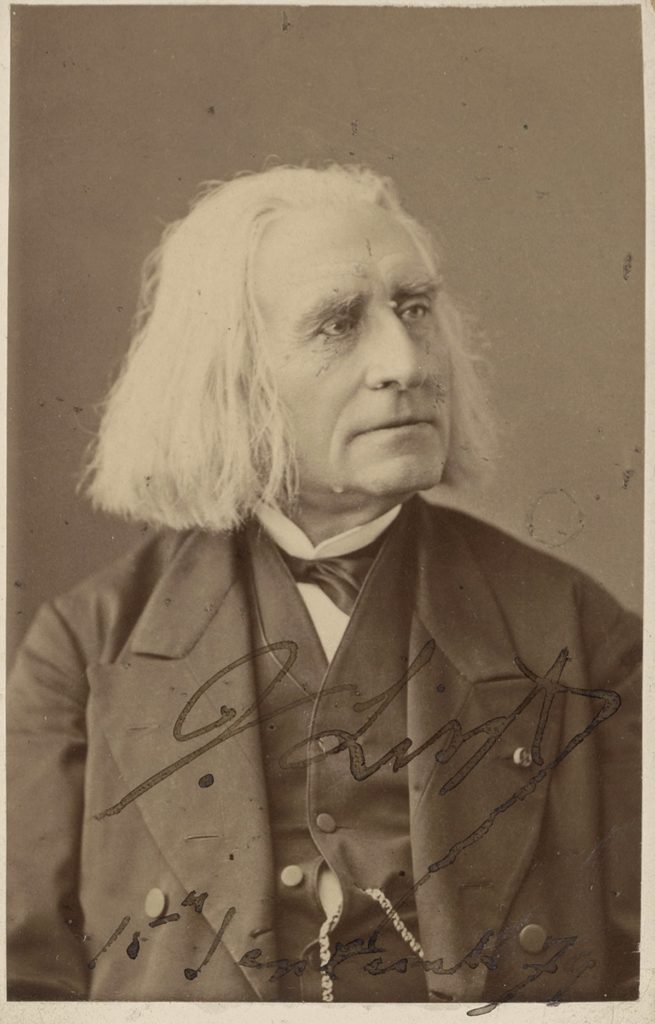
As far as I know, photographs from this session by Julien Ganz have always been dated May 1881, Bruxelles (also in Ernst Burger books). Meanwhile, I have found this scan of a photograph with Liszt’s handwriting on it: “15 Septembre 79”, so it is correct to assume that the session probably took place in 1879 or before.
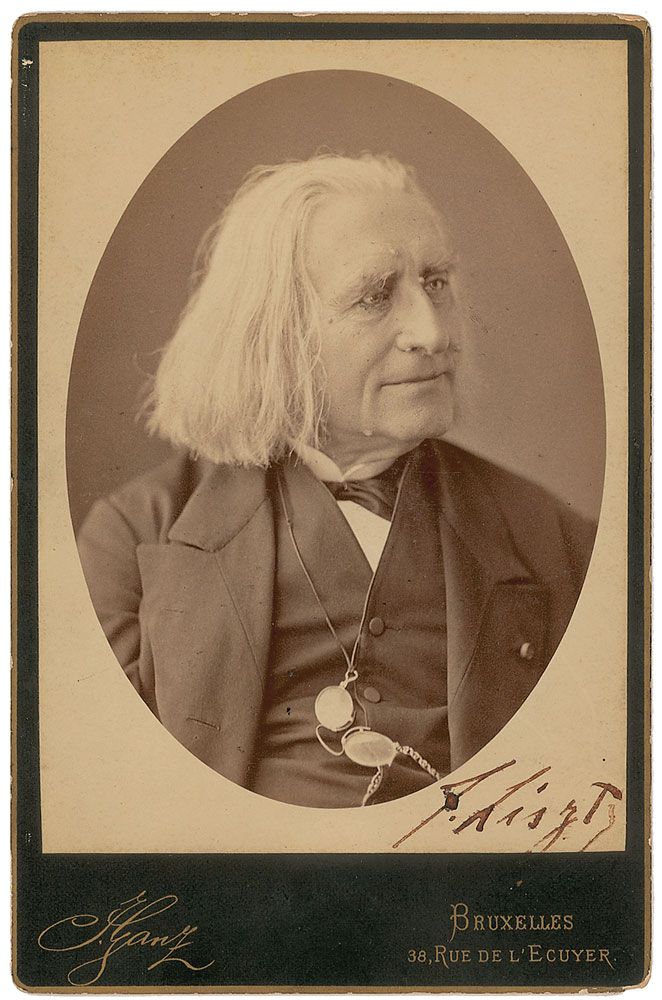
This picture of Liszt prompted me to take up a challenge. It is signed by Liszt with the inscription “15 septembre 79”. In the comment accompanying the picture, that I can confirm, it was mentioned that all sources (including Ernst Burger) dated it 1881. The current “story behind” will attempt to reply to the following question: was this picture – and by extension the other pictures of this Ganz series in Brussels – taken in 1879 or 1881?
In a previous “story behind” (that can be read here: https://www.dianekolin.com/2021/10/story-behind-series-24-october-13-2021/), I found traces of Liszt in Brussels in 1881 and 1882, in both press reviews and biographies. Moreover, Julien Ganz, the photographer, who was also a cellist and a fan of Liszt, documented Liszt’s 1881 concerts in Belgium, noting the programs of the concerts he attended.
Interestingly the picture in my previous post was taken in 1881 but signed in 1882, which made me look more closely at dates, and the reason why it was the case.
Alan Walker, in his Liszt biography, detailed the trip of 1879. As usual, Liszt travelled between Rome, Budapest, and Weimar. He was in Budapest in January, and in April he spent time in Vienna, Hanover, and Frankfurt, so not far from Belgium. It could have been plausible that he stopped there on his way since he did so in May 1881. However, the reason he stopped in Brussels and Antwerp in 1881 was due to invitations to attend festivals where his music was performed, which didn’t occur in 1879.
When Liszt went somewhere, even when he was staying with family or friends, the press was aware and published about it, thus, it is easy to peruse the numerous articles available and follow Liszt’s path. I went through 10 different Belgian newspapers in French and Dutch, there is nothing regarding a potential stay of Liszt in Belgium in 1879, however it is full of reports of his Belgian trips of 1881 (for several festivals and concerts in Brussels and Antwerp in May – see programs in my earlier post) and 1882 (for a performance of his “Legend of St. Elizabeth” oratorio in Brussels in May). On both occasions, he stopped at Julien Ganz’s studio.
Looking at the series of pictures that Ganz himself documented and dated in 1881 and 1882, we can find the one originally posted but also some from the same series with the same watch, glasses, and clothes. Here is another picture from the same series.
One of the other elements of comparison is the length of his hair. Another picture of him surrounded by his pupils Juliusz Zarebski, Franz Servais and Johanna Wenzel, was taken by Ganz in his studio in Brussels in 1881: https://www.dianekolin.com/2021/05/story-behind-series-11-may-13-2021/. I guess that the session started with the one with the pupils, and then Ganz asked to do individual shots. As for 1882, here is one of the pictures of the Ganz series: https://www.dianekolin.com/2021/05/story-behind-series-12-may-16-2021/. Hence, I don’t believe Liszt stood in Brussels in 1879.
So what could have been the reason for the handwritten indication on the picture? In Weimar, Liszt kept a box full of pictures that he reserved for pupils, friends, and family – and sometimes special guests. Occasionally, he opened the box and asked someone to pick up a picture, then he was signing it and sometimes wrote something personal on it. For instance, he wrote 1882 on one of the pictures taken by Julien Ganz in 1881. My theory is that someone chose this picture in the box and asked him when it was taken, after what he wrote “15 septembre 79,” or it was for a purpose totally unrelated to the picture itself.
What I like with mysteries is the part that will never be solved.
Published on Franz Liszt Group, on December 11, 2021. If you want to know how the Story Behind series started, I give details in “Story Behind” Series #1″.
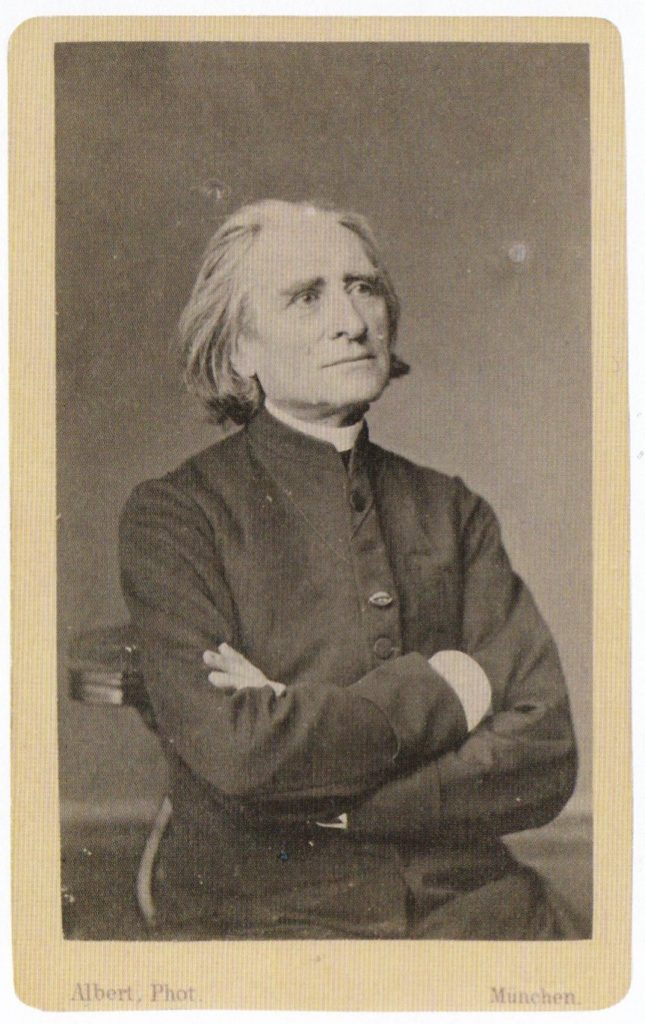
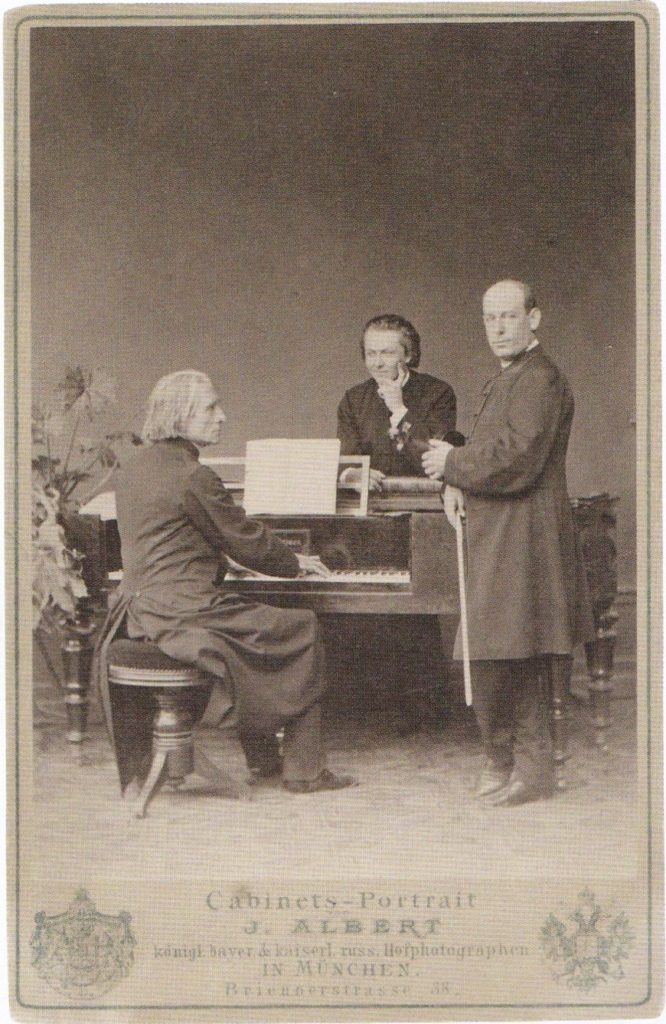
This picture is part of a series of photographs taken in Munich in September or October 1867 by Joseph Albert. Among them, the famous picture of Liszt sitting at the piano with Ede Reményi and Nándor Plotényi.
As for the picture I chose, I like it because it is the only one of the series in which we see Liszt smile. I like his pose too. Maybe he was told that he always looked serious, and it would be nice to have at least one picture of him smiling.
More about the photographer. Born in Munich in 1825, Joseph Albert was an accomplished chemist and applied his skills to photographic inventions. At the age of 25, he opened his photography studio, located at Brienner Strasse 8B, using glass plates to develop the first photomechanical printing technique. He became court photographer (Hoffotographer) of the Bavarian royal family in 1857. He photographed Maximilian II and his young son, who ascended to the throne after his father’s death as Ludwig II. He became famous for his photographs of the royal events as well as Bavarian castles and buildings of great historical and cultural significance. In 1868, he introduced the Albertype, which allowed photographs to be successfully reproduced and printed onto paper, linen, and silk. The Albertype revolutionized the photo printing industry by allowing a flatbed press to produce up to 1,000 copies at a time. His photographs of composer Richard Wagner, taken over a period of nearly 20 years, are among his most celebrated works. In 1882, he opened his gallery in Karlstrasse, where the portraits of some of Germany’s most distinguished dignitaries where exhibited. He died in May 1886, a few months before Liszt.
Now, back to Liszt, and what happened in his life during the year 1867. In March, Liszt transferred to his uncle, Dr. Eduard Liszt, his title of nobility(von). The title was necessary to marry the Princess Carolyne zu Sayn-Wittgenstein without her losing her privileges, but he didn’t want to keep it after the marriage fell through. Eduard’s son and Franz Liszt’s cousin, also called Franz, became Franz von Liszt. He worked on his coronation mass in Santa Francesca Romana until April 14th. The original version, performed for the coronation of Emperor Franz Joseph and Empress Sisi (Elisabeth) as King and Queen of Hungary in the Matthias Church in Pest on June 8, 1867, was a short mass with only six movements, and a duration of approximately half an hour. After the first performance he added the Offertory, and two years later the Gradual. The violin solo in the Benedictus was originally composed for Ede Reményi, but he couldn’t come to Pest (the solo was played by Joseph Hellmesberger instead). However, as shown in one of the pictures from the Albert series, they could reunite briefly in Munich. Liszt stood in Pest from June 4 to 16, then went back to Rome. Traveling back to Germany at the end of July, he stopped in Weimar, Eisenach and Munich where the picture was taken. He stood in Munich from September 20 to October 28. His then goes to Tribschen in Switzerland to talk to Wagner about his liaison with Cosima. Back in Rome on November 2nd, he made a piano transcription of Isolde’s Liebestod from Wagner’s Tristan.
Published on Franz Liszt Group, on November 5, 2021. If you want to know how the Story Behind series started, I give details in “Story Behind” Series #1″.
Two weeks ago, I posted a “story behind” about an 1871 series of Liszt pictures taken by Fritz Luckhardt in Vienna. I mentioned that Liszt liked these pictures a lot and ordered some copies to sign for friends and to be used as visit cards.
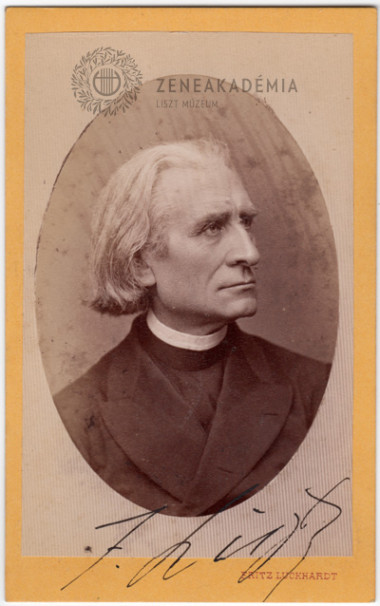
On April 23rd, 1871, Liszt arrived in Vienna. As he was doing each time he was in the Viennese city, he stayed at the Schottenhof, his uncle Franz von Liszt’s place, for some quiet time with his family, until May 2nd. It is during this period that Luckhardt took the series of pictures.
In October 2020, the Liszt Museum Foundation of the Liszt Academy in Budapest purchased one of these visit cards signed by Liszt’s hand. It is rare enough to be acknowledged here. The picture posted is the one that was acquired. I enjoy the fact that these treasures can still be found today. I wish to thank the person who informed me about this initiative.
The purchase announcement says:
“The generous donation of pianist Tibor Szász made it possible for the Liszt Museum Foundation to buy a visiting card with photo and signature of Liszt, created in the Viennese studio of Fritz Luckhardt, 1871. Tibor Szász took his doctorate at the University of Michigan; having held positions at three universities in the USA, he finally became professor of the Hochschule für Musik Freiburg between 1993 and 2018 [Note from Diane Kolin: Tibor Szász is still teaching in Freiburg]. He published extensively on the music of Liszt, Mozart and Beethoven: his study of the Sonata in B minor – considered as a great achievement in Liszt scholarship and translated to several languages – came out in the Journal of the American Liszt Society, and his article about Beethoven and the basso continuo practice can be found in the Cambridge Studies in Performance Practice series. Tibor Szász is giving a concert at the Liszt Museum next year.
Besides the high-value signed photo of Liszt, the Foundation purchased two other visiting cards from the 1860s at the same HT auction: one represents Lajos Haynald, cardinal of Kalocsa (by Ágoston Bülch, Pest), while the other shows János Danielik, canon of Eger, privy councillor of the Pope (by J. Ruwner, Vienna) – both of them belonged to the circle of Liszt’s important Hungarian friends.”