Published on Franz Liszt Group, on June 28, 2021. If you want to know how the Story Behind series started, I give details in “Story Behind” Series #1″.
Original post:
“Brahms’ Variations are better than mine, but mine were written before his”. Franz Liszt
Story behind the picture and the quote, and conversation:
Diane Kolin
Here is a new “story behind” post.
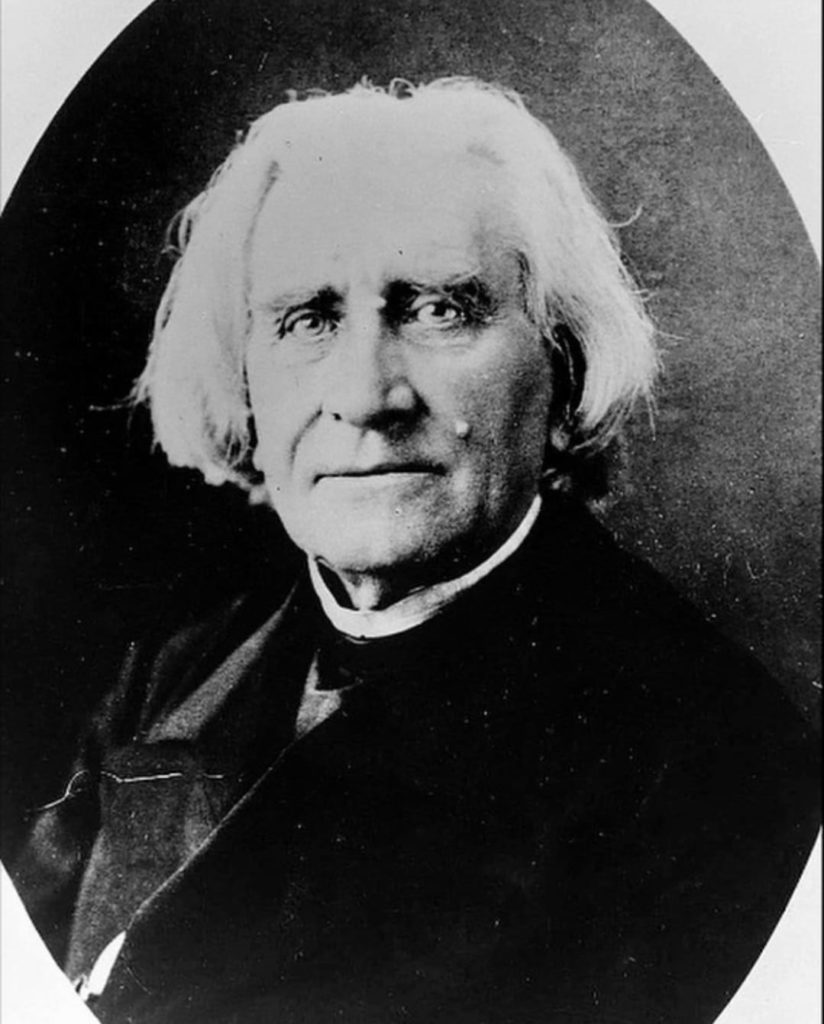
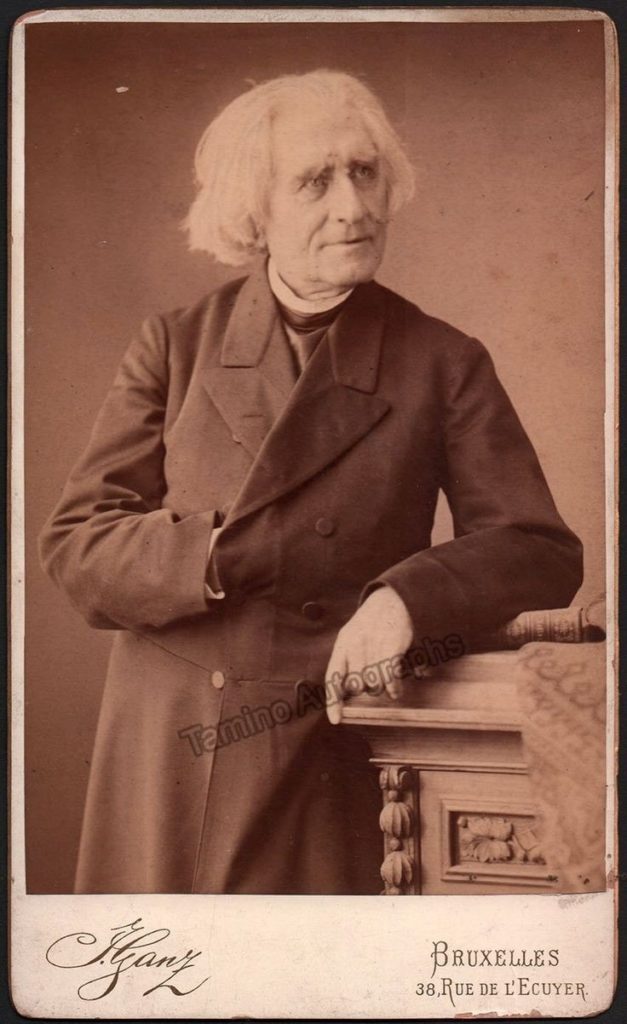
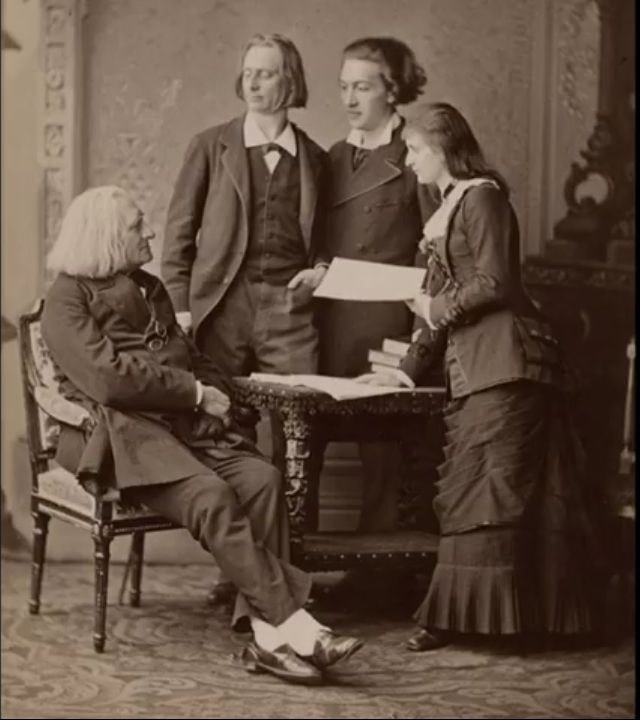
The picture is part of the same series taken by the Belgian photographer Julien Ganz in Brussels. Another picture from the same series was posted on May 16 on this group. It was taken in May 1882, in the middle of his usual travels from and to the cities of his “vie trifurquée”: Rome, Budapest, and Weimar.
As for the quote, it is from his pupil Arthur Friedheim’s book “Life and Liszt” (published in 1961), that was also mentioned a few weeks ago. In this passage, Friedheim relates a meeting he had with Brahms, who mentioned his Paganini Variations. Friedheim told Brahms about a conversation he once had with Liszt regarding both sets, the “Paganini-Brahms” and the “Paganini-Liszt” Variations. Friedheim reported that Liszt said: “Brahms’ Variations are better than mine, but mine were written before his”, after what Brahms replied (I am quoting Friedheim’s text): “And that alone,” laughed Brahms, “makes Liszt’s better than mine.” (p. 138)
Group member 1
Yes, I am not so impressed by that Liszt quote, he usually did better. Maybe there is a pun hidden in French or German?
Diane Kolin
I agree with you. I will try to dig and locate the excerpt in the original text in German (if I can find it somewhere). Also, we must remember that this is a quote that someone (with all the respect I have for Friedheim) said Liszt said. We will never know if it was really said and what was said exactly
Note: I didn’t find the original text in German yet.
Group member 2
In all fairness to Liszt, his variations could never have competed with those of Brahms, since Liszt bound himself to write a note-for-note pianistic replica of the 24th Caprice for violin solo in A minor by Paganini. Hence, Liszt’s Paganini Variations are not his own music, but that of Paganini; only the pianistic idiom is Liszt’s own. To judge fairly any event in life, it must be evaluated within its own full context.It is just as with music: its building blocks gain ever new expressions within the varying contexts in which they occur. Bartók was a fan of the Rachmaninov variations.
I have been challenged to use the AI algorithm with drawings and paintings only. The difficulty is to find portraits on which Liszt’s face presents enough elements to be detected and interpreted. Like for the previous animated pictures videos, I have included the original painting or drawing as a point of comparison. You will see that the tool has more difficulty generating a face from a drawing than from a painting. Enjoy!
Published on Franz Liszt Group, on June 11, 2021. If you want to know how the Story Behind series started, I give details in “Story Behind” Series #1″.
Original post:
This post was slightly different from the others. Someone posted this video, called “Rare uncovered audio & footage – Franz Liszt masterclass late 19th century”. It received many comments. Some believed it was true, some not. Of course, this is a fake. I posted a special “story behind” to explain why, based on the group members’ comments. First of all, here is the first video:
The last video showing the pretended (and fake) recording of Liszt’s masterclass made much noise 🙂 I wanted to propose a special “story behind” for this occasion. I saw some comments that are worth exploring together.
First of all, here is the original video. It is an excerpt of the excellent series of 16 episodes of the biopic “Liszt Ferenc”, a Hungarian TV show of 1982: https://www.imdb.com/title/tt0156218/?ref_=fn_al_tt_1. I regret that this series was never subtitled, as it is pretty good and covers a lot in Liszt’s life based on the documentation that was available at the time of the production.
The episode in question is episode 14, and the excerpt in question (which was very badly treated in this fake video) can be found at 6:42.
Then a few questions are of interest:
“When did Liszt die?” 31 July 1886
“When was recorded sound invented?” First sound captured in Paris by Édouard-Léon Scott de Martinville in the late 1850s, using the same technique as the daguerreotype (see my “story behind” post about the first picture taken of Liszt), nearly two decades before Alexander Graham Bell’s first telephone call (1876) or Thomas Edison’s phonograph (1877). Too bad nobody had the idea to go to Liszt and record him play. Of course, the recording techniques, including the piano rolls, appeared only later, way too late for Liszt’s sound to be captured.
“When was ‘moving pictures’ ie filming invented?” First commercial public screening of the Lumière brothers on 28 December 1895.
“Also you’ll notice that the ‘surface noise’ of the recording has been superimposed over a turn of the century (or even later) recording.” True. Totally fake 🙂
“Liszt was much heavier than that actor in his old age.” Not true, they actually took an actor that was “similar” to Liszt. The only part that is incorrect is his height. He was not that tall. As someone said: “That DOES NOT even look like Liszt….for a start…. Liszt was 6 foot tall – that imposter is not 6 foot.” True, but the poor man we see here was not an imposter, he was an actor, and a pretty good one, I think. The idea was not to make him “look like” Liszt but to have someone who could play a credible Liszt character. I think he did a good job, and so did the younger actor who played young Liszt. For those who are curious, the 16 episodes can be found on YouTube: https://youtube.com/playlist?list=PLhfQMVLniY_q_MuUZDmi4muhNXJ_scxxR
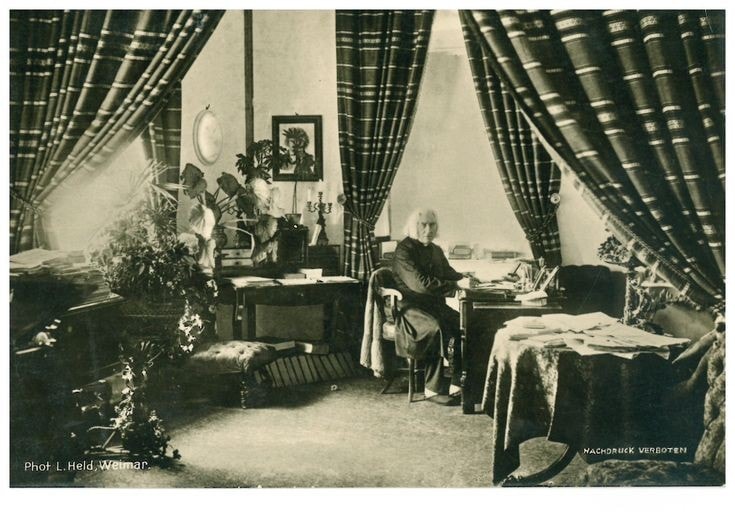
“All the photos and paintings of Liszt’s masterclasses show he only use grand piano…. an upright for Liszt? How improper…” Not true. First of all, there are some paintings and pictures where we can see Liszt sitting at an upright, and then, this series was entirely shot in the real places where Liszt lived and travelled. This is the Hofgärtnerei in Weimar, which can still be visited today (https://www.tripadvisor.com.sg%2FAttraction_Review-g187426-d243448-Reviews-Liszt_Haus-Weimar_Thuringia.html). Both instruments are also still in the room. During his masterclasses, Liszt used both his grand piano (a Bechstein that we can see on the images) and his straight piano for accompaniment (the last upright was an Ibach, delivered in April 1885, still in the room today, and before that it was a Höhle, a local brand). Either him or other pupils used to sit and play from the grand piano for the lesson, and Liszt asked for volunteers to sit at the second piano, or did so himself, to accompany the other one. Now, it is true that most of the lessons were given on the grand piano, not on the straight one. All this is described in details in the writings of the pupils, some of the references were mentioned in earlier posts, for example the post with the picture taken by Held in 1884 where we can see Liszt at his writing desk. This is the same room that we can see in this movie.
“Liszt was a very very old man when the first b&w film was shot. Much older then this film showed.” Liszt was indeed dead when the first b&w film was shot.
Published on Franz Liszt Group, on June 7, 2021. If you want to know how the Story Behind series started, I give details in “Story Behind” Series #1″.
Original post:
My piano is to me what a ship is to the sailor, what a steed is to the Arab. It is the intimate personal depository of everything that stirred wildly in my brain during the most impassioned days of my youth. It was there that all my wishes, all my dreams, all my joys, and all my sorrows lay. Franz Liszt
Conversation and story behind:
Diane Kolin
Hello friends. Here we have both Young Liszt and Old Liszt. Time for a new “story behind” 🙂
The quote was written by Liszt to his friend Adolphe Pictet, a Swiss linguist, philologist and ethnologist, in Chambéry in September 1837. It was first published by Liszt himself in the French Musical Journal in which he was frequently writing, the Revue et Gazette Musicale de Paris, on February 11, 1838. In this journal, Liszt published a series of letters under the name “Lettres d’un bachelier ès musique” (known, in English, as “An Artist’s Journey”). In these letters, he is writing to his friends to explain what music means to him. The quote in this post is a perfect illustration of the kind of content that could be found in these writings. Lina Ramann mentioned these quote and letter in the first part of her biography of Liszt (English translation: “Franz Liszt, Artist and Man, 1811-1840”, Volume 2), in German. Then the whole set of original French letters was published. You can find all the letters of “An Artist’s Journey” in an English translation of 1989 by Charles Suttoni, in University of Chicago Press. I highly recommend them. There are 16 letters in total, addressed to George Sand, Hector Berlioz, and other important figures of Liszt’s circle in the 1830s and 40s.
The picture is a famous one of Old Liszt taken by Louis Held, who was a frequent guest in 1884 and 1885 to photograph the Master and his pupils. Here, you can see him at his writing desk in June 1884 in his house in Weimar, the Hofgärtnerei. Today, when you visit the Liszt-Haus in Weimar, the furniture, portraits, and desks are still at the exact same place. A few weeks ago, a picture was posted representing Liszt siting in a park with his pupil Carl Lachmund and wife Caroline Lachmund. This one was also taken by Louis Held in 1884. Lachmund wrote a very detailed journal about his years studying with Liszt, from 1882 to 1884, “Living with Liszt”, in which he wrote about the day the picture was taken. Despite the serious look (which is not rare for Liszt in pictures), he was in a good mood and decided to accept Held’s request to have him sitting at his desk for a picture. Caroline and Carl were also present. Caroline took care of Liszt’s hair, and Carl arranged the books – he placed volumes by Bach and Beethoven on the piano so that the names could be recognized (we can see the scores on the piano on the left). Lachmund related that Liszt had to stay still for a full minute so that the picture could be taken.
Group member:
Lachmund’s diary is indeed excellent reading, both for its descriptions of Liszt, as well as his impressions of his fellow students, some of whom would go on to become the greatest pianists of their generation. Along the same lines, I also recommend heartily the reminiscences of Arthur Friedheim and Siloti. The better-known diary of Amy Fay, which recounts the second Weimar period of the 1870s, is also interesting reading, particularly as she compares and contrasts Liszt, Tausig, and Rubinstein. Additionally, and likely most significantly, Rosenthal wrote his memoirs, which were housed in manuscript in the Mannes School of Music, but recently published, I believe. Rosenthal, who was held in great esteem by Liszt, asserts that Liszt’s famed youthful crisis upon hearing Paganini, which sent him practicing for twelve hours a day, was something of a myth. It was not Paganini, but none other than Chopin, who precipitated the crisis. Liszt, according to Rosenthal, told the latter that he could not bring himself to publicly admit that it was another pianist that drove him into such intense study!
Diane Kolin:
Absolutely 🙂
Amy Fay wrote “Music-study in Germany” in 1913. She spent part of the year 1873 as his student and described in details what it was to be Liszt’s pupil. As Andrew Gentile said, this one is not only about Liszt but about the very rich German musical life: Tausig, Clara Schumann, Joachim, Rubinstein, Kullak, Wagner, von Bülow, Deppe…
As for Siloti and Friedheim, both tell their life as one of the Master’s students during the last years of his life, with a lot of discussions about the pieces they were practicing with him and how the masterclasses were organized. In 1986 a book called “Remembering Franz Liszt” was published, containing both journals in English.
Alexander Siloti wrote “My Memories of Liszt”, first published in German in 1903. It is a short but pretty complete report on his life in Weimar.
Arthur Friedheim wrote “Life and Liszt”, first published in English in 1961. He started studying with Liszt in 1879, until he died in 1886. It is a journal, but it also tells the reader about Liszt’s life, his correspondence, his writings… Very interesting book.
In the students’ writings about Liszt in old age as a teacher, there are also the memories of August Stradal, who published some score sketches by Liszt and pictured the man and the teacher, and August Göllerich, who listed all the pieces performed by the students during the masterclasses from 1884 to 1886, with comments and directions by Liszt.
To learn about the earlier masterclass period, when Liszt was in his 40s, Liszt’s student William Mason wrote “Memories of a musical life”, published in 1900, in which he relates his life in America and in Europe. A good part of the book is about his studies with Liszt in Weimar during two years, from 1853 to 1854. After Mason left, they wrote to each other until a few days before Liszt died. But in this book, like Amy Fay did, he also talk about Moscheles, Wagner, Schumann, Joachim, Chopin, Thalberg, Rubinstein, and other musical personalities of the time he was in Germany.
Keep reading 🙂
(Note: Isn’t it fabulous to exchange references? The conversation continued and other references were given but the topic became focused on another subject.)
Published on Franz Liszt Group, on June 1, 2021. If you want to know how the Story Behind series started, I give details in “Story Behind” Series #1″.
Original post (posted by me):
Unfortunately it is not with music as with painting and poetry: body and soul are not enough to make it comprehensible; it has to be performed, and very well performed too, to be understood and felt. Franz Liszt
We haven’t seen a picture and a quotation for quite a while, so I decided to post both, and to tell a new “story behind”.
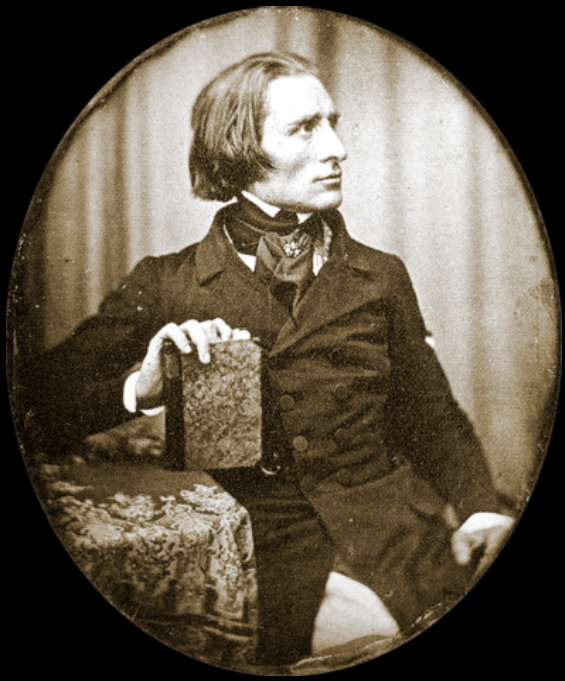
The picture, first. This is an important one. It is the earliest known photograph taken of Liszt. In fact, it is not a photograph, it is called a daguerreotype, after the name of the inventor of this early photographic technique, Louis-Jacques-Mandé Daguerre. It consists of silver-coated, polished copper plates that are made light-sensitive with iodine vapors immediately before the photograph is taken. After exposure in a camera obscura, the latent image is developed with mercury vapors and fixed with saline solution, then watered and dried. The finished positive was unique, so there was no negative and therefore no prints. The photographed object was reversed, this is why a reflex mirror was occasionally used later. This daguerreotype was taken by Hermann Biow who opened one of the first photographic studios of Germany in Altona, and then in Hamburg. It was done on June 27, 1843 in Hamburg, for the purpose of an exhibition of portraits. This portrait can be seen the way people saw it at the exhibition.
The quote, now. This is an excerpt of a letter Liszt wrote to his friend the Abbé de Lamennais on April 28, 1845. He was in Marseilles, France, at that time, in the middle of his European touring years. I tried to choose a quote that was written approximately at the same period the picture was taken. In this letter, Liszt talks about a score of a vocal work that Lamennais suggested him to compose. The music in question is not known. He told Lamennais that he finished it but he didn’t want to share the score with him, he wanted him to hear the music. In the same letter he is also mentioning the Beethoven Monument in Bonn (the one that he almost entirely financed) and the Cantata he wrote for the inauguration. About the text used for the Cantata, he wrote in this letter: “The text, at any rate, is tolerably new; it is a sort of Magnificat of human Genius conquered by God in the eternal revelation through time and space, – a text which might apply equally well to Goethe or Columbus, as to Beethoven.”
I hope you enjoyed this new “story behind” episode 🙂
Published on Franz Liszt Group, on May 16, 2021. If you want to know how the Story Behind series started, I give details in “Story Behind” Series #1″.
(Foreword: this quote is not from Liszt. I give the details further.)
Original post:
I love you sometimes foolishly and at these moments I do not understand that I could not, would not, and should not be so absorbing a thought for you as you are for me… Franz Liszt
Hello friends, here is a new “story behind” post.
A few days ago, a picture by the same photographer, Julien Ganz, was posted, also taken when Liszt was visiting Brussels, Belgium. This one was taken later than the previous one, in May 1882. Last time I forgot to remind Liszt fell down the stairs of his home in Weimar in July 1881. His close circle of friends and pupils reported that “he suddenly became older.” In his final years Liszt continued to travel a lot despite his increasing health issues. The two series of pictures taken by Julien Ganz were in May 1881 and in May 1882. This picture is part of the 82 series. Comparing the two, we can really see the signs of him getting older and more tired. He stopped in Brussels during one of his trips between Rome, Budapest, and Weimar.
As for the quote, guess what? It is not from Liszt! It was written in May 1833 by Marie d’Agoult to Liszt. Alan Walker talks about it in the first volume of his Liszt biography. It is published in “Correspondance de Liszt et de la Comtesse d’Agoult,” edited by Daniel Ollivier, in volume 1. It was before they were living together, they were writing passionate love letters to each other. They lived together between 1835 to 1839. During this time, three children were born: Blandine, Cosima and Daniel. Then Liszt’s call for touring Europe became bigger than their love, and the relation ended.
Published on Franz Liszt Group, on May 13, 2021. If you want to know how the Story Behind series started, I give details in “Story Behind” Series #1″.
Original post:
As the mother teaches her children how to express themselves in their language, so one Gypsy musician teaches the other. They have never shown any need for notation. Liszt
Story behind:
Hello friends 🙂 Here are the stories behind the quote and the picture.
Another picture of Liszt with his students, but this time by another photographer. This one was taken in 1881 by Julien Ganz in Brussels, Belgium. On the picture, from left to right, we have Liszt, Juliusz Zarebski, Franz Servais and Johanna Wenzel (who became Johanna Wenzel-Zarebski, I guess it helps to be part of the Liszt community ;)). Franz Servais was a cellist and a composer, Juliusz Zarebski and Johanna Wenzel were pianists.
As for the quote, it is from Liszt’s essay about Gypsy and Music I have mentioned in a previous “story behind” post. The book is called “The Gypsy in Music” (in French: “Des Bohémiens et de leur musique en Hongrie”) and was published in 1859. Actually if you want to read about the story of this book, Liszt’s student Arthur Friedheim talks about it extensively in his book “Life and Liszt” in the chapter called “Liszt the Writer” towards the end of the book, as an appendix. Friedheim was Liszt’s pupil for six years in Weimar, from 1880 to 1886. “Life and Liszt” is a good testimony about the late masterclasses period, and about the life of a pianist of the Nineteenth century.
Published on Franz Liszt Group, on May 12, 2021. If you want to know how the Story Behind series started, I give details in “Story Behind” Series #1″.
Orignial post:
Truth is a great flirt. Franz Liszt
Story behind:
Hello, everybody 🙂 Here are the stories behind the quote and the picture.
The quote first. It is taken a bit out of its original context. It can be found in a letter Liszt wrote to Olga von Meyendorff on May 5, 1882, in Brussels. Olga just sent him the text of a speech given at the Académie Française by Joseph Ernest Renan, a French scholar specialized in Semitic languages, civilizations, religion, philosophy, and politics. As Liszt was very interested in anything related to politics, and in religion too of course, he often asked his friends to send him any text that could be of interest to him. In the case of Renan’s text, he didn’t like it at all. He wrote Meyendorff about it:
“Thank you for the Academy speech of Renan, “the unctuous skeptic.” He proves with elegance that Truth is a great flirt, and that it rather enjoys respectable absurdities.”
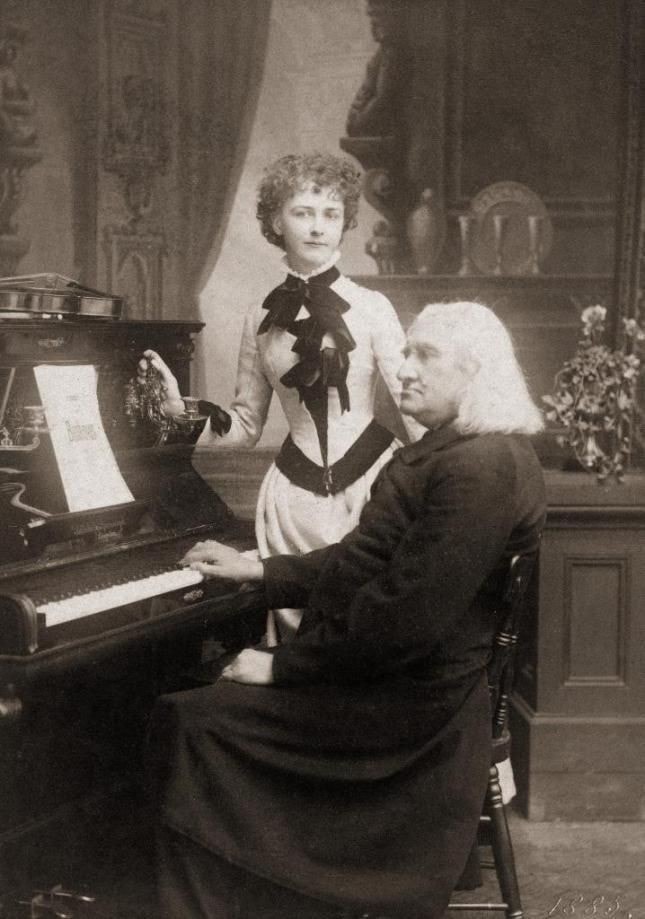
Now, the picture. I already talked about the photographer in an earlier “story behind” post. This picture was taken in 1885 by Louis Held, who came in 1884 and 1885 in Weimar to photography Liszt and his students. This one represents Liszt accompanying the violinist Arma Senkrah. Interesting fact about this violinist: her real name was Anna Harkness; she wanted to take a pseudonym as a performer, so she wrote her name backward, and voilà. She was popular within the Liszt circle. Hans von Bülow, who liked to play with words and letters, once signed an autograph to her as “Snah nov Wolub” 🙂
Here is the last video of the series of animated Liszt pictures generated with the new AI algorithm. This is the final period, 1876 to 1886. Once again, I added the original pictures for you to compare with the animated ones. It might not be the last one as I have been challenged to prepare a video containing only paintings and drawings. Stay tuned.
Published on Franz Liszt Group, on May 8, 2021. If you want to know how the Story Behind series started, I give details in “Story Behind” Series #1″.
Original post:
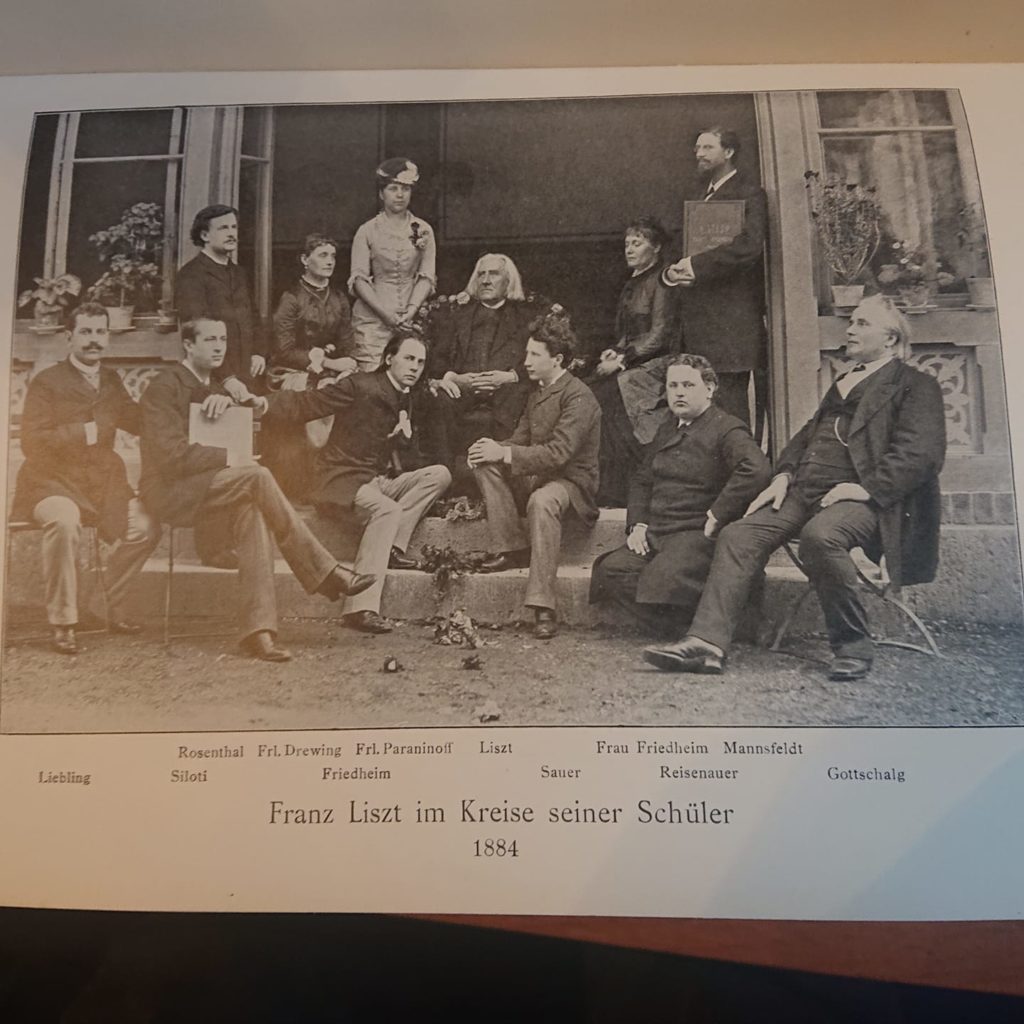
I have this famous photo in a book. “Franz Liszt in Weimar”, from Gottschalg’s diary, published 1909.
Conversation and story behind:
Diane Kolin:
Ahhhh I love this picture 🙂 It was taken by Louis Held in 1884 in Weimar for Liszt’s 73rd birthday (October 22, 1884). It represents Liszt surrounded by his students. Here is the complete list.
Top row, from left to right: Moriz Rosenthal, Viktoria Drewing, Mele Paraninoff, Franz Liszt, Annette Hempel-Friedheim (Arthur Friedheim’s mother), Hugo Mansfeld.
Bottom row, from left to right: Saul “Sally” Liebling, Alexander Siloti, Arthur Friedheim, Emil Sauer, Alfred Reisenauer, Alexander Wilhelm Gottschalg.
Group member:
Yes, but Gottschalg writes that the birthday was celebrated the day after, funny enough.
Diane Kolin:
Ah I didn’t know, thanks for telling 🙂 Now I have to look at the story behind it, haha 🙂
Group member:
Could be a typo (but he had footproblems (Fussleiden) two weeks earlier).
Diane Kolin:
I had a look and found the story. There were two different nights. The picture was taken on October 22, 1884, which was confirmed by the photographer Louis Held who dated his photo. It was taken in front of the Armbrust’s Restaurant in Weimar. Then the next day they had a private celebration with a few friends, including Gottschlag. I found the entry in the book pretty sad. The note is dated October 23, and says (translated from German): “Liszt celebrates his 74th birthday in a small circle, C. Rene and others also joined. He’s getting weaker and weaker. For the first time he complains of the infirmities of old age. Decrease in vision and hearing.” He rarely talked about health matters outside his close circle of friends.