


Category: Music and Disability

  • Performing with a Different Body: Re-imagining Music-making

    Paper presented at York University, Toronto, on April 21st, 2022, during the MUSI 6010 PhD Colloquium. It was presented live and has not been recorded. The abstract below gives you an idea of the content.
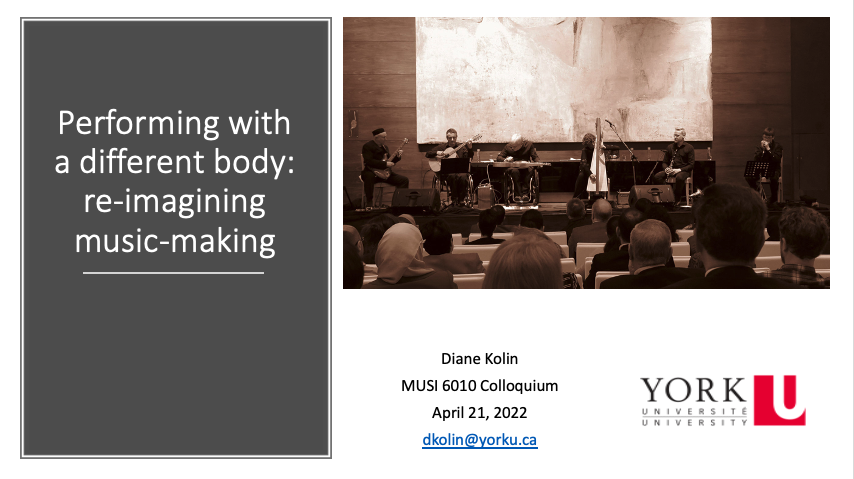

    The title is displayed, along with a picture representing a small ensemble of musicians with and without disability. The name of the conference and the York University logo is also displayed.

    Abstract:

    How does someone without arms play French Horn? How does someone with bent arms play violin?  How do musicians with differently developed bodies make music? Like all musicians, they need a team of supporters. Their teams, however, also include instrument inventors and builders. In this paper, I explore the experience of three professional musicians who I have interviewed about their musical journeys, born without arms, with a different shape of body, or with a progressing disability. 

    Following Blake Howe’s study of the one-handed pianist Paul Wittgenstein (2010), I use social and cultural models of disability and mediation theory as a framework to examine the relationship between music-making, differently shaped or functioning bodies, and disability, leading the musicians to new instruments and practices. The concept of separation between disability and impairment emerged from the social model of disability (Barnes, 2012), from which the cultural model borrows its approach of disability pride (Mitchell & Snyder, 2012). Although disability pride has been adopted by musicians who consider that disability is part of their identity and should not be seen in negative ways assumed by our current society, the three musicians are differently affected by disability pride. I discuss how their disability led them to different directions, whether they consider it as the motor of their actions or as a simple fact that has little to do with their musicianship.  I use mediation theory (Prior, 2018) to discuss how new technology can reshape the conventional form of instruments. Based on the experience of these three musicians, I suggest that unconventional thinking and re-imagination of the confines of traditional music-making can open the profession of music to all, no matter what kind of bodies we are born with, and allow more inclusive musical performance practices.

    Keywords: Disability, adaptations, inclusivity.
  • Vibrations, deafness and music: from Ludwig van Beethoven to Evelyn Glennie

    Paper presented at York University, Toronto, on January 14th, 2022, and during the Carleton University Music and Culture Graduate Student Society 2022 Symposium, Ottawa, on March 26th, 2022. Both presentations were live and were not recorded. The following abstract gives an idea of the content.


    Abstract:

    How does someone deaf hear music? Is there another approach to sound when the ears are not working? In this paper, based on the assumption that deafness is incompatible with sound, thus with music, I explore the interconnections between hearing impairments and music-making, from the nineteenth century to today. Through the journey of musicians with hearing issues, I assert that the multiple tools and techniques developed for and by these musicians have transformed society’s assumptions about disability and music. Through the study of the history of devices related to hearing loss, I examine the progression of the technologies available, and the choices of using these technologies made by deaf musicians.

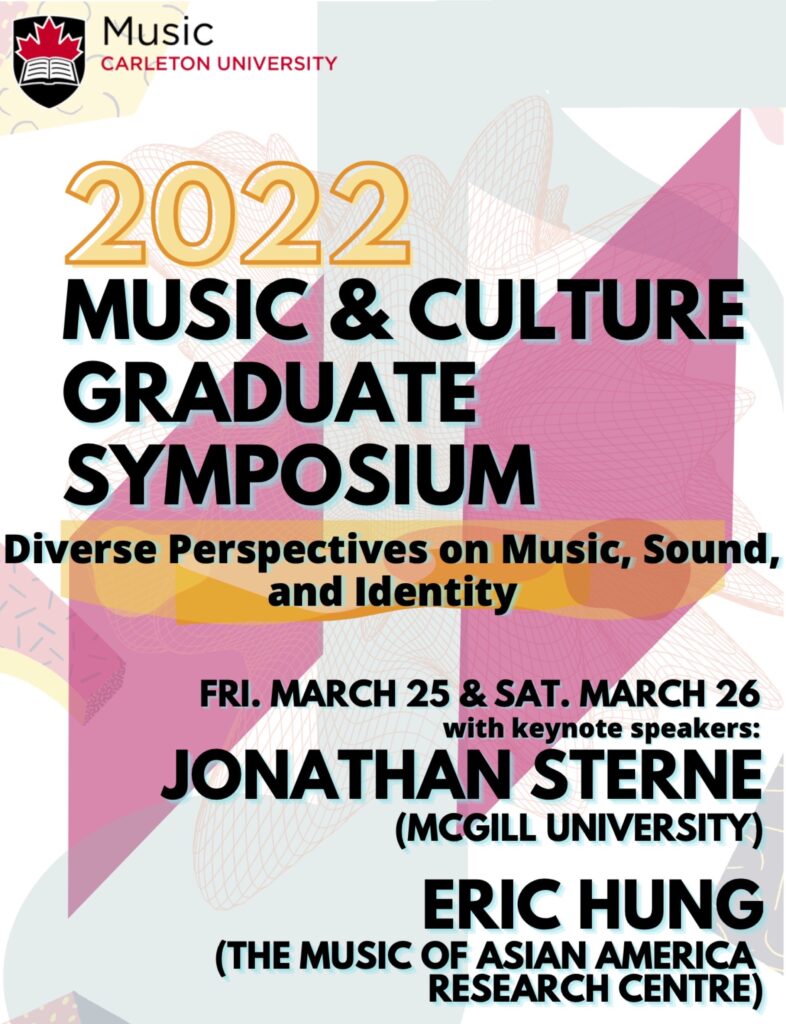
    Poster announcing the 2022 Music and Culture Graduate Symposium of Carleton University, and the keynote speakers Jonathan Sterne and Eric Hung.
  • Music as a Tool for Disability Activism

    Article published in “Music & Politics in the Moment” – Issue No. 1: Music and Protest/Demonstration, December 2021


    Abstract:

    The relationship between disability and music/the arts has been documented in various disability activism movements of the twentieth and twenty-first centuries. In the domain of Critical Disability Studies (CDS), scholars have explored the different stages of disability activism in our society. In this article, I explain how CDS has changed the vision of disability thanks to artistic initiatives, and how different models of disability differ in relation to arts and culture. I give an overview of disability activism in the arts more generally and in music in particular. Events that have impacted disability inclusion in the professional music world are given as examples. I enhance my study with narratives of disabled musicians I have interviewed.

    Read the article: https://currentsinmusicresearch.ii.lsa.umich.edu/articles/music-and-protest-demonstration/music-as-a-tool-for-disability-activism/

    Alternative version: https://yorkspace.library.yorku.ca/xmlui/bitstream/handle/10315/38853/Kolin_2021_Music%20as%20a%20Tool%20for%20Disability%20Activism.pdf?sequence=1&isAllowed=y

  • Strength for the journey: Music-making and Critical Disability Studies

    Paper presented during the Carleton University Music and Culture Graduate Student Society 2021 Symposium on March 20th, 2021, the 2021 Midwest Graduate Music Consortium on April 11th, 2021, and the uOttawa Graduate Music Student Conference on April 16th, 2021.


    Abstract:

    It is often assumed that inquiry between music and disability is limited to the field of music therapy. I argue that a musician with a disability can develop a strong professional career, provided that a key adaptation occurs along the journey.

    This paper explores methods employed by professional musicians to succeed in their careers despite their disability. It is illustrated by interviews of three different musicians, living in three different parts of the world, who chose three different instruments.

    After defining what Critical Disability Studies can bring to music by examining the existing literature on music and disability, I propose an analytical approach of the three interviews, on medical issues, embodiment, perception, adaptation and accessibility. The past, present and vision of the future of the three musicians are addressed and show contrasting journeys and perspectives. The essay highlights how each artist was able to make use of their own reflections on their musical journey.

    Based on the three case studies and the literary works already available on the subject, the paper finishes by providing a model for reflection to build a bridge between the music field and Critical Disability Studies to allow a complementarity that is rarely addressed in both scholarships.

  • How professional musicians pursue their activities during the pandemic

    Paper presented during the symposium “Music, Mediation, and Disability: Representation and Access” on November 21st, 2020.


    Abstract:

    This comparative study is part of a larger research project examining the life of professional musicians, conductors, or composers with a disability since the first documented case studies of musicians dealing with a handicap.

    The present article concerns the challenges facing three disabled professional musicians during the global pandemic and describes in detail the mediation strategies they have developed during the lockdown period imposed by COVID-19 to continue their work, despite their disability. Each of them is usually active with a very busy schedule. Each is from a different age group. Each presents a unique disability, though all are physical in nature.

    The study explores the necessity of teamwork and collaboration to pursue musical activities, the choices made in their use of new technologies, and what issues they faced with tools that are sometimes incompatible with their infirmity.

    Guidelines are also given based on these experiences.